



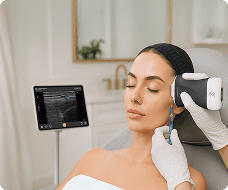


Dr. Ines Verner explains how to scan the nasolabial fold to address the danger of an intravascular injection in the angular artery. She recommends scanning both the right and left sides as location and depth of the artery can vary from side to side. Watch Dr. Verner safely inject her patient after mapping the angular arteries.
a dangerous zone that we do have to check is the nasolabial fold the nasolabial fold is injected a lot but there is the angular artery there and we really need to check where it is what depth it is so we are not injecting into the angular artery now many anatomical studies that have been done have showed that the angular artery is quite superficial and so this area may be safe when you go deep to the bone but on the other hand there is so much variability between people and sometimes the artery can be quite deep and so there is still a risk for intravascular injection so i will capture the image and then i will actually measure the depth of the artery and vein there they're here and so the distance is gonna be four millimeters 3.6 millimeter depth so i can actually go deeper so in this in her case if i do the nasolabial fold and i go deep deeper to the bone i will be actually safe because the angular artery and vein are at around three millimeters so i'll do again i'll just go deep into that area when injecting also i will map the other side directly so we actually know where to inject so the vessels are there and here again i can measure and see that they're around three three point three millimeters depth so that's um that's where the angular artery is and so i can inject that area safely if i go deeper than that so now i can actually inject the nasolabial fold after i've done the mapping i know where the vessel is and i know that it is three millimeters depth and i'm going to inject much deeper so i'm gonna actually go to the bone much much deeper than the vessels are so i will actually not risk going intravascular so i'll go here i will aspirate just in case in this area and then i know that i'm good and so i can inject a little bit and i'm done and the same i can do on the other side i go deep and the vessels are not deep so i'm actually good so again here i'll go here i am aspirating just in case and i know i'm actually much deeper than the vessels are so we're done and that's it you