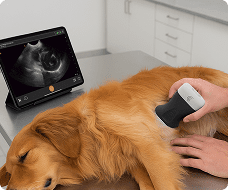
this case is a malnuted seven-year-old Miniature Schnauzer with a history of diarrhea and vomiting so here we have um a cranial abdomen view where we can see the diaphragm along here this is the chest cavity and we can just see the heart beating in here this high power structure here is the liver and we can see a little bit pocket of free fluid there and possibly some in the cranial part of the abdomen also and here we're Fanning through and it becomes more clear that there is free fluid surrounding the liver here a little close-up of that um so we've got mesentry here and we've got the edge of the liver and then this anechoic content here is free fluid here we've got the gallbladder the liver is hypoechoic and we can see that because the portal veins are standing out more obviously than they would do normally the transverse view of the liver Fanning through so we have a horizontal line of the diaphragm and at the end of the loop we can see the heart another view of the liver where we can see a bit of free fluid between the liver and the diaphragm this is the heart beyond just measuring the free fluid can give us an indication of how uh how much there is and also we can quantify if it is changing over time Fanning through the liver again here we're looking at the stomach so this is the stomach wall this is the gas in the Lumen and the stomach wall is very thickened so we'd normally expect that to be closer to the three millimeters and here we've got it at seven millimeters another view of the stomach here with some Regal folds and we're just Fanning down towards the pylorus there we have the spleen with some splenic vessels a much more homogeneous structure than the liver um and uh we can we're looking up towards the splenic head here moving down the splenic body this spleen looks very normal here the left kidney we can see here there's the cortex medulla's in here and this is the peripelvic tissue we're just measuring the length of it at 4.4 centimeters I'm Fanning all the way through we can see little pockets of free fluid around here too so there's a big triangular anechoic content here which is free fluid so here we have the left kidney in transverse here we've got the cortex medulla and the pelvis area here we're following the aorta quarterly um to look for the left medial iliac lymph node so here's the aorta this is the external iliac artery and we're founding in this region to look for the left medial iliac lymph node there's none obvious here so we presume that's normal now we're following the aorta cranially we can see the renal artery leaving the a water here so we know we're in the region of the left adrenal around here and here we have the left adrenal for the cranial pole and the caudal pole we can see pockets of free fluid in all these images too so now we're looking at Jared Unum so we've got a transverse Loop jejunum here we can see some peristalsis in this Loop of intestine and we can also see free fluid in the abdomen around the intestines here we're measuring the geodunal wall here that looks very normal with a thick mucosal layer and a normal submucosa muscularis and serosal layers and at four millimeters just under five millimeters it's slightly thickened but the wall looking much more normal than the stomach wall there looking at more Loops of chair junum and seeing that surrounding uh free fluid also have the bladder here in the chordal image here we have a closer up of the bladder fairly empty and small but the bladder wall is still very very thin just found in quarterly to the prostate not very obvious in this neutered male here we have another loop of geodunum in longitudinal a more normal measurement there and very normal looking wall foreign Al lymph node they tend to be quite long and mildly hypoechoic compared to surrounding tissue it should be under a centimeter in dogs which this is well under here we've got the vessel that runs between the geodunal lymph nodes and we can see one lymph node up here and one just below it when we fan through here measuring the geodunal lymph node again we turn the dog over and we're looking at the diaphragm the gallbladder here was a little bit of sludge in there the wall is quite hyperechoic but I feel that that is due to the liver being so hypoechoic in this case rather than there being too much um to say about the gallbladder um there appears to be a little bit of sludge in there too the right kidney seen here measuring similar to the other side looking the duodenum so we've got this nice straight Loop of intestine that's very superficial very close to the body wall uh measuring um a nice normal thickness there and the wall layering looking normal so this is in transverse the geodenum so we've got the lumen in the middle we've got then got the mucosa on both sides submucosa and thin muscularis and thin serosa and on the side of the duodene and we can see this triangular structure and it's a little bit highlighted because there is free fluid in the abdomen so we can actually see the pancreas here the right limb of the pancreas sort of floating around in their societies there we go we're measuring the right limb of the pancreas there we can also see this anechoic tube that runs through the pancreas and that is the pancreatico duodenal vein so here is the area that around the ascending colon and we saw this dilated area um of of intestine here again we can see this dilated Loop of intestine here here we can see the uh called winner Cava closest and the aorta and where they are separating moving cranially in the abdomen we can see the right adrenal here measuring at 4.92 millimeters here we can see that right adrenal so we've got the quarter vena cava coming down here we've got the aorta here we can see the left renal artery and the cranial mesenteric and the Celiac arteries there we can even spot the left adrenal there and then the right adrenal oval on this side foreign so in this case we found a moderate amount of free fluids seen throughout the abdomen the mesenteric fat appeared a bit hyperechoic and reactive you're sending colon and the ileocecalcolic junction appeared a bit dilated but no obvious obstruction was seen on an ultrasound on this dog an exploratory laparotomy followed and histology was samples were taken from the small intestine and that found that there was a chronic moderate to marked lymphoplasmacytic and neutrophilic enteritis with Villa stunting and lymph ectasia foreign