



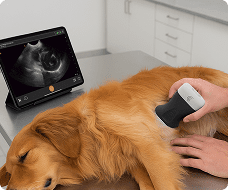


Dr. Camilla Edwards demonstrates her technique to image the pancreas. In this video, she identifies helpful landmarks for localization, and describes the normal ultrasound appearance of the canine pancreas.
hello i'm dr camilla edwards from first opinion veterinary ultrasound and today i'm going to teach you how to scan the pancreas we'll start with the left limb of the pancreas we need to start by looking for the descending colon we find that above the bladder we go dorsal to the bladder where we find this gas-filled structure which is the colon we follow that in longitudinal cranially and where that dips off we'll see the spleen coming into view and that's where the colon goes into the transverse colon we want our three landmarks in the image so we want our stomach cranially the spleen dorsally and the transverse colon chordally so in this area we'll see cranial we have the stomach cordal we have the transverse colon and dorsal we have the spleen and we can see the splenic vein leaving the spleen and it's in this area we'll see the left limb of the pancreas the left limb of the pancreas is isoechoic and not very long in the dog so it can be very hard to spot but once we've fanned in this area and we haven't seen any abnormalities we can be sure that the left limb of the pancreas is normal so now we've turned pippi over into left lateral recumbency and we're going to look for the right limb of the pancreas so we start up near the kidney near the right kidney and we bring the probe ventrally down the abdomen we're looking for the duodenum which is the first loop of small intestine that we come across so we pass the colon and there at the top we've got the the duodenum this is the first so it's the most dorsal most superficial loop and most straight loop of intestine that we come across we can see that moving across the screen with some peristalsis happening as well in there so we find the duodenum which is the most dorsal most superficial most straight loop of small intestine going across the screen here at the top and the right limb of the pancreas lies medially to the duodenum so just on the other side of the duodenum here we can see there's a lot of gas and food in the duodenum so this can obstruct our view sometimes um we can also follow it cranially to the pylorodiodinal junction where we will see more of the body of the pancreas so to get a good view of the pancreas it can sometimes uh be advantageous to get a transverse view so if we rotate the probe 90 degrees we should get this triangular structure on the side of the duodenum which is the pancreas we can see the right limb of the pancreas is very isoechoic um it has the pancreaticoduodenal vein running through it so there's a small anechoic structure in the center of it and that can help us to identify it particularly in the transverse view