




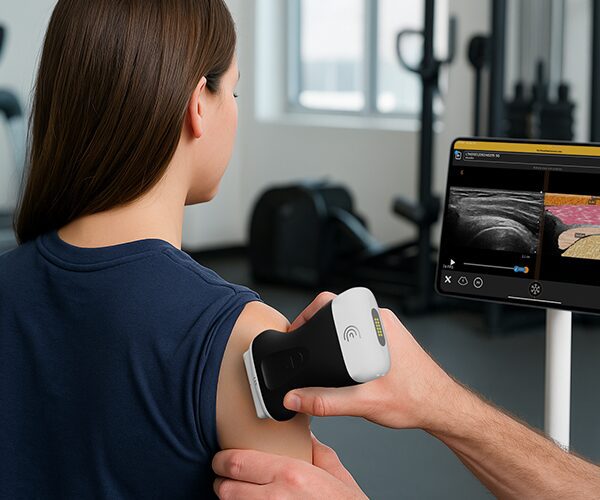
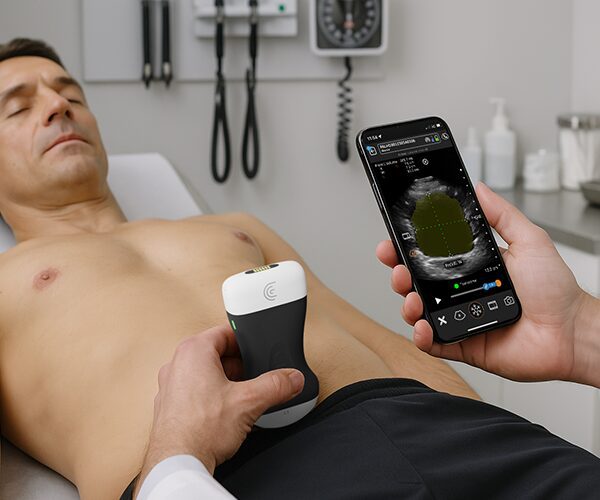


Fundamental cardiac view for evaluation of left ventricle function, basic aortic valve assessment, and pericardial effusion. With indicator on screen right, probe’s indicator aims to the right shoulder at about 2nd-3rd intercostal space. Find your best window, then small fan and rotation movements to optimize the image.
in a patient presenting with chest pain dyspnea or hypotension the parasternal long and short axis views of the heart can provide significant information about cardiac function at the bedside to perform this scan i'm going to use the phased array scanner on the cardiac preset and i'm going to place it at the left sternal border i like to break this scan up into several different steps the first one is window shopping so by holding the transducer at one angle i'm going to slide up and down that left sternal border to find the window where the heart appears its brightest through the lung once i'm happiest with my window from here i'm going to fan for the middle that means tilting the transducer towards the patient's head or towards his feet to find the valves opening up at their maximal diameter once i'm happy with that i'm going to then just rotate the transducer to find the ventricle open up to its widest width when i found an image that i really like with a great window good opening valves and the widest possible ventricle i now can identify the different features of the heart i see the right ventricle at the top of the screen the left ventricle at the bottom i see the aortic outflow track and the left atrium and the descending thoracic aorta behind the very bright pericardium to now reach my parasternal short axis it's just a simple rotation from the same window towards the patient's left shoulder and i'll see the left ventricle come into view here as the round donut with the croissant of the right ventricle up on its left you can see here the mitral valve is right at the window in the middle of the ventricle and so to get it at the ideal mid ventricular view i'm going to slowly just slide the transducer towards the ventricle until i have a nice round symmetrically squeezing left ventricle once i've scanned through the long and the short axis i can feel confident on assessing the various features of his cardiac function you