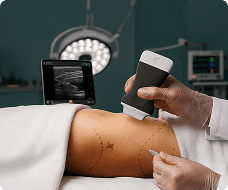
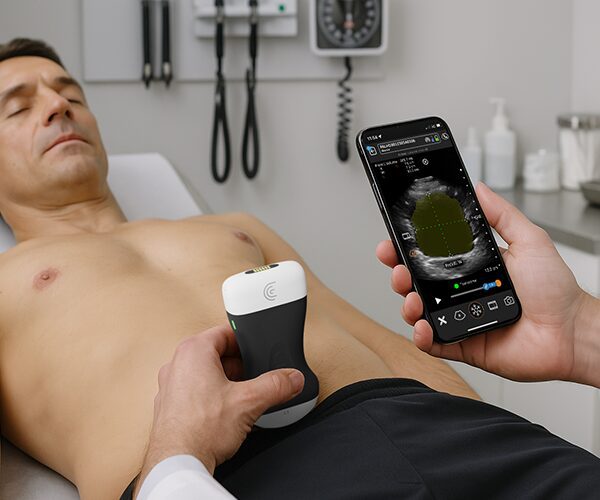
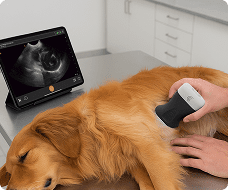
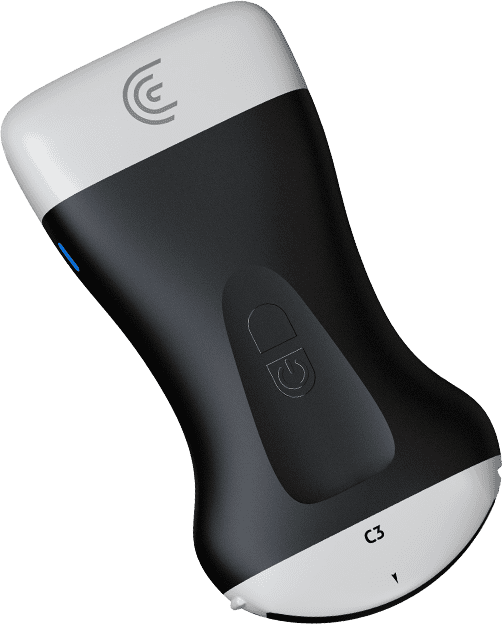
hello everyone and thank you for joining us and i'm serge and i am cern and this is penny we can't forget penny true so she's going to help us demonstrate the abdominal point of care ultrasound exam okay so tell me more about that dr poison so this is something that evolved from the fast scan that we published in 2004 looking for free fluid in the abdomen of dogs suffering from trauma we've come a long way from that original fast scan and the goal of looking for fluid in the abdomen and we're now looking for a lot of other pathologies which we will go through shortly and that's why we've sort of changed the name from the fast exam to the point of carol sound because it includes a lot more than fluid and we can answer a lot more questions now when we're doing our abdominal pony kerosene so this is our five-point abdominal pony carrot sound or five point a pocus exam so we're gonna go ahead and show you that real quick we're gonna do this in real time and then we're gonna show you once we've got this uh exam done we're gonna show you each site and all the questions we answer at those sites we're just gonna show you a general overview of how we do this 5.8 focus exam so we're going to go ahead and start with that sub-ziphoroid site separate the first so you can see the skin so that you get a good image quality marker towards the head and we're going to come in and pop the probe in at that subsequent location that gives us a nice view of that sub-zephoid site so that's really quick how we find that at an angle about 45 degrees following that subzyphoid site we're going to come back and we're going to do the umbilical site and to the umbilical side again we just separate the fur apply the alcohol essentially at that site where we'd get a scar if we were doing our ovarial hysterectomy we put the probe on at that umbilical site and there we're going to angle the probe down if we're looking for fluid but we can also look for other structures there like the spleen and we'll go through that in more detail as well following that umbilical sight we're just going to lift the leg up a little bit we're going to come back and get that urinary bladder site so again we apply alcohol separate the first so we can see the skin we'll pop the probe in there and we're going to actually just find that urinary bladder and we're going to scan that site as well so we get that urinary bladder site once we've got that urinary bladder site we're going to come up we're going to find in this case our dog is in left lateral so pennies and left lateral here we're going to go after that sublumbar site to do that just trace the ribs up till you actually lose your finger in the sub lumbar muscles where it gets pushed out on that last rib so we just traced that dorsally find that sublumbar site again we're going to separate the fur so we can see the skin we're going to apply alcohol there and now we're going to place the probe with the marker again starting towards the head and we're going to pop on at that right paralumbar site now in the right paralumber site we won't always be able to see the kidney uh because of the location in this case here we actually can see it quite nicely just behind the ribs sometimes we'll have to jump into a space between the ribs but we'll show you as well in penny here we actually have a really nice view of that right kidney at this right paralumber site once we finish scanning our patient in lateral if our patient isn't lateral we'll roll our patient up into sternor standing and we'll do the exact same thing for the left parallel bar site so we scan our patients in the position they're most comfortable if they're in a sternal or standing position we'll look at all five sites with them in that standing position if they're in lateral recumbency we do what we just showed you here we scan the four sites then roll them up and get that last site so we're scanning all five sites in all our patients regardless of how they present and we scan them in the position the most comfortable the other thing we will do at each site in addition to that long axis view we will also do the short axis at all five sites as well so we do long and short access to each of those sites so that's our general overview it literally takes us about 60 seconds to 90 seconds to do an o'donnell point of care ultrasound exam now and we'll go through each site in more detail and explain all the questions we answer at those five sites sounds excellent we'll be back you