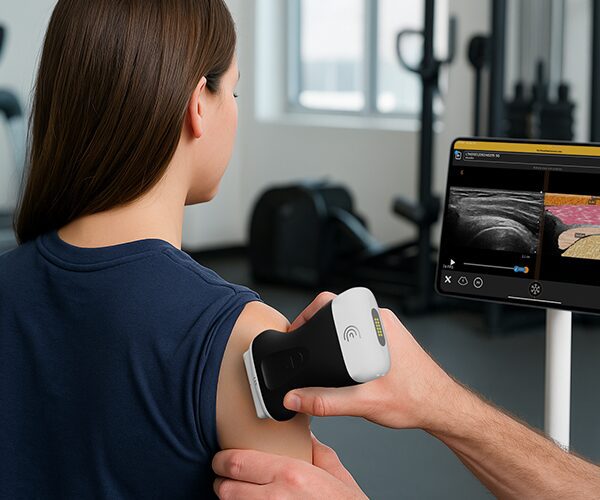
the second approach is the dorsal approach and the dorsal approach is my favorite approach uh because you can really see well the insertion of the disl BP standon to the radial tuberosity and the patient position has also a really cool name and that is the Cobra uh position so the patient is seated again on the other side of the table leaning on the oanon uh and placing uh the hand in this pronation um and this make sure that the U dozal part uh uh is opened up of the arm and that you can really see the insertion of dis bicep standon you can see in the other one the ventral approach you could not see the insertion but this is really focusing on the insertion so the transducer is being plac on this dorsal aspect of uh the elbow in transverse View and what we can see now is uh we can see the uh nna right here and this is uh the radius uh so this is the uh radio nner joint with in between we can see the disle bicep standon uh inserting to the radial tuity and the cool thing is uh with this transducer position that we can look at it from a dynamical perspective so we can rotate the transducer and see again the disle uh biceps tendon uh stretching uh at its insertion meaning that we can see it we can see that it is been stretched so it is there it is not torn um we're going to scan this this bicep standon a little bit more to uh towards the table and a little bit uh in the other direction so that we can see the full fibers of this distal uh bicep standon insertion we're not only assessing uh so the static uh position we're also going to uh see the dynamical uh position and what you're going to pay attention to is do I do you see the tendon do you see also a Bersa so the B bpto radial basius could also be present and do we see any signs of impingements which could also happen in between the um uh the radius and enna within the radioa joint due to for example a calcification having checked this in this longitud position we could uh turn the transducer in longitudinal right if if you can keep it like this down right um now we can see that this is again the radial tuberosity and um uh the previous one was the longitudinal view on the fibers this is a transverse view on the fibus and what we see is that at the level of uh the insertion that this is the transverse view on the full insertion of the distal uh biceps so these are all transverse distal biceps uh fibers and you can see how yeah wide this insertion to the radial tuberosity um is so with this dorsal approach you can see U the full insertion to the radial tuberosity