



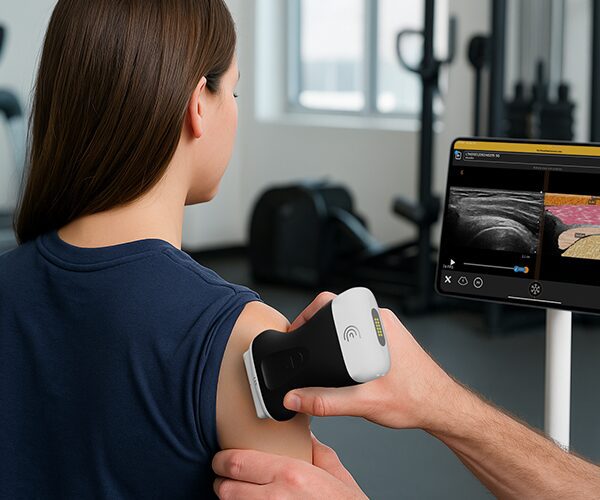


With the patient’s arm in a slightly flexed position, and the scanner placed in line with the humerus, Marc describes the movement of the scanner medially until the brachial artery is visualized. The artery acts as a landmark, and as an acoustic window to optimize imaging of the biceps tendon, including the insertion.
the fourth and last approach is the medial approach uh to scan the dis biceps ton um and because uh if I would scan now on this arm you would not be able to see it so for dactic purposes we are going to take uh the other arm um so we're going to scan on the medial side and to do so uh the tendon should be a little bit on a pre-stretch so we're going to ask the patient to actively hold this uh this this somewhat flexed elbow position then the transducer is going to be placed in line with the humoral bone and um uh we're going to start uh right here and then we're going to move the transducer uh uh to distal to distal and somewhat to proximal or to some to ventral and what we are going to look at is is to see whether we can find the brachial artery right here so this is the brachial artery and this is a very clear Landmark uh for you to be able to see the disle bicep standon because now in this approach the disle bicep standon is underneath so this is the distal bicep standon inserting to the distal uh to the radial tuberosity bone um this uh braal artery is not only a uh important Landmark but it also a acoustic window for you to optimally see the distal bicep standon so now we can see the the whole thisle B bicep sendon right here with its uh full uh insertion right there again we're going to scan back and forth to see every part of the thisle bicep standon and we're going to look for uh signs of uh tearing of the biceps but also fluid accumulations May maybe du due to the basius and uh for uh strange foreign bodies or maybe calcifications so try to keep uh the biceps standing a little bit more horizontal in screen screen like I'm doing right now to avoid anisotropy and to increase the echogenicity and to do so you need to tip in the distal transducer tip a little bit more into uh the the skin so this was the uh four fourth and last approach to scan the uh this bicep standing