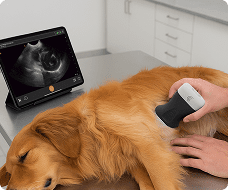
welcome back everyone i'm serge and i'm cern and now dr wisem we had forgotten a kidney and we had to change the dog around to be able to find it absolutely so when we're doing our patients in lateral recumbency if they have a fracture or something and that's the position that they're most comfortable we'll scan them completely in that lateral position and then we've got to try and get that gravity dependent uh paralumbar site and we'll either try to tuck the probe underneath the patient with them in lateral or we can flip them as we've done in penny here into the opposite lateral position if that's comfortable for them so we can access that left paralumbar site the other thing we can do we often will do is we'll get all five sites with them in a standing position in which case we don't have to actually change the position they're in but for demonstration purposes we've got penny now in right lateral recumbency to allow us to look for that left paralumbar site and this is essentially exactly the same thing we're going to trace those ribs up find that last rib palpate that trace that up with our fingers until we hit that spot where the paralumbar muscles push our finger out and that's where we're going to look for that left kidney so serge is going to do that for our left paralumbar site and he's going to pop the probe in with the marker towards the head and there's our kidney in long axis and the questions that we're going to ask and answer with that probe and long axis we're going to fan off one side we're going to fan off the other side we're going to make sure we have no free fluid in the abdomen at this location we're also going to look for retroperitoneal free fluid at this site as well so we'll make sure we have no retroperitoneal injury or fluid accumulating in the retroperitoneal space or the abdominal space and just like on the right paralumbar site we also are going to look for the short axis and we're going to fan all the way through one side of the kidney and fan all the way through the other side of the kidney again looking for free fluid or looking for retroperitoneal fluid and because this is the non-gravity dependent site we're going to look for that free air at this location as well so we're going to find that peritoneal lining as we see again here and we're just going to check for that reverberation artifact and enhance peritoneal stripe sign to look for the presence of free air in the abdomen at this location as well and the final thing surgery in short axis so at this left parallel site the left kidney usually tends a little bit easier for us to be able to identify and assess that renal pelvis for dilation again more applicable in cats than in dogs so surge has the short axis here and he's just going to fan slowly back and forth until he can pick up that paralumbar left renal pelvis in short axis so again he's just there we go we're just looking for that renal pelvis and we're looking for that pacman coming off the renal pelvis and again in a normal cat or dog it's pretty rare that we'll see any dilation so it's not uncommon not to see that very clearly at all in our healthy patients we're also seeing the spleen come in here dr boison and this is that left paralumbar site we often find a tail of the spleen here and when we actually found through that again nice spot there it is beautifully demonstrated we want to look for free fluid between the kidney and the spleen like you see here or surrounding that spleen at this site complements that umbilical site we talked about earlier very nicely when it comes to looking for free fluid and that is the left paralumbar site