



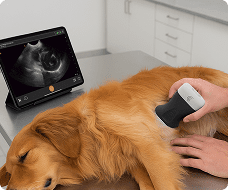


The Abdominal FAST is used for animals who have had trauma and those who have not had trauma – anaphylaxis, pericardial effusions, pleural effusions, non-traumatic haemoabdomen and peritonitis. It is used to detect small amounts of free fluid in the peritoneal, retroperitoneal, pleural and pericardial spaces.
hi i'm dr camilla edwards from first opinion veterinary ultrasound today i'll be demonstrating how to use the clarius to do an abdominal fast scan on a dog so first we want to get the diaphragmatico hepatic view where we place the probe behind the zippy sternum in a sagittal view we fan down through the gallbladder and we rock cranially to get the diaphragm view and the liver view and then we return to our sagittal position the next view we want to get is the spleno renal view to do that we place the probe up on the flank where we can see the kidney and the spleen and we fan all the way through the kidney we rock cranially so we're seeing the cranial end of the kidney and then we return to our sagittal position the third view is the sister colic view so we want a view of the bladder and the colon and we place the probe looking up through the bladder towards the colon we found all the way through the bladder down towards the table and we rock cranially to see that cranial end that's down towards the dependent side of the table and then we return to our sagittal position the fourth view is the hepato renal umbilical view and we just place the probe here just underneath the dog will often get a bit of spleen and a bit of small intestines in the view and we can fan all the way up there we've got the spleen all the way down through the small intestines to get the real dependent view where fluid will gather due to gravity the fifth view we can get which is a bonus view is that plato renal view so if you want to roll heavy up we can look up towards the spine roll her back down again so the hepato renal view got the right kidney and the spleen the liver so we fan right through the kidney rock cranially in that position and then we return to our saggital position okay you