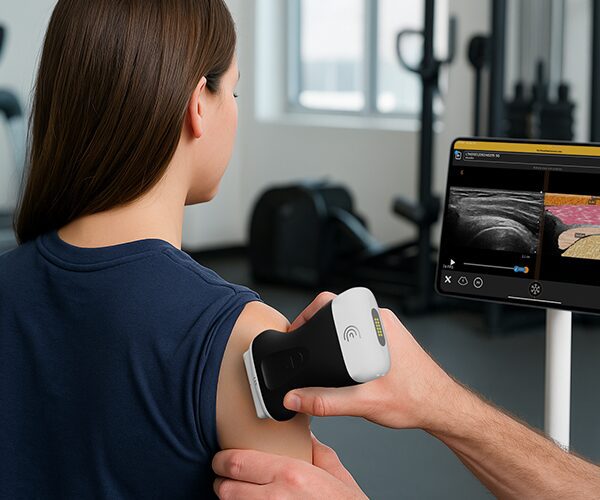
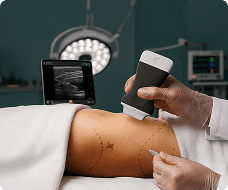
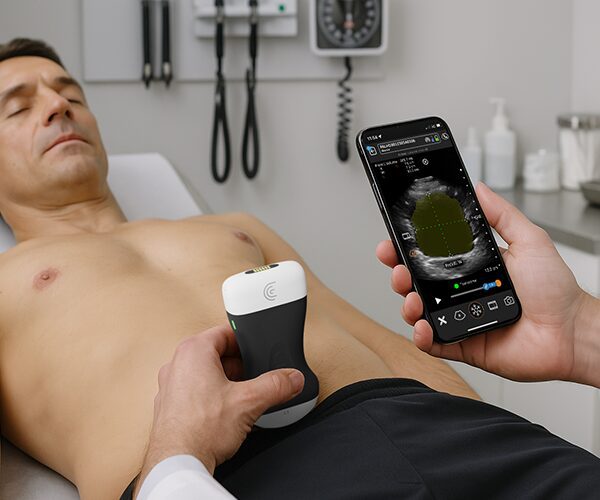
focusing on the tocenteric region we there is a there are a few things to to look at for example the glutial tendons but also maybe a toenterantic bersza if that is present. So the patient is in this sideline position with the affected hip pointing upwards and then uh I have put a pillow or a large bolster underneath the leg so that there is less stress on this toanteric region and that fluids or burs of fluids are not being pushed away so that we can easily check them. to scan the uh glutial tendons. First thing to do is placing the transducer in transverse view over the femural shaft and uh then uh looking uh from here sliding more towards proximal until uh we can see that the smooth uh bone of the femural shaft uh is becoming more pointy [snorts] uh and irregular. So for example here now we have a more pointy appearance and that is indeed the greater tokant. If we are at tokant level I can slide with the transducer to vententral then you will see that there is a small concavity right there in this anterior facet of the greater and this uh holds a uh structure with is the glutius minimus tendon. So this is the glutius minimus in transverse view. So if you want to check that then we're going to slide up and a little bit down to distal and uh a little bit more on this side to see the tendon uh and observe for any uh echogenicity changes uh swelling for example if there is a large convexity of the tendon increase of cross-sectional area and also the uh bone if that regular or maybe irregular. Uh after having checked the glutius minimus tendon in transverse view, uh I can go to a longitudinal view on this uh glutial tendon and uh then what we see now is that this is the glutius minimus in longitudinal view. So if we slide to uh to proximal then you will see the tendon right here and then uh transitioning uh right there in the muscle tissue. So sliding back to uh the glutius minimus. So let's turn the transducer back in this uh transverse view. Uh then we can see uh that on the uh lateral facet of the um the toontto major the greater tcont we can see the glutius medius. So this is the glutius medius the glute net and uh also here we're going to slide up to proximal. You can see that in his case the glutius medius appears to be a little bit more hypercoic. The glutius minimus uh appear to be a little bit more hypoaccoic. Uh so hyperaccoic appearance is a is a is the the normal appearance and then um we slide over uh this uh this this area right there and going to observe for any changes in shape. For for example is the tendon increased in thickness or maybe decreased in thickness. is uh the echogenicity has a change and do we signs of uh ruptures uh full or partial uh ruptures after we've checked it in a transverse view also we're going to uh rotate the transducer to longitudinal view and from here on we're going to uh slide and follow the glutius medius indeed to uh to proximal and then this is the muscular tendonous junction uh right there And [snorts] uh uh from here you can see all uh tenderness and this is the glutius medius inserting to the greater toconta. So uh in this region um uh the bersza is um the bersza should be there at least many people are being referred for a tocenteric bersza but in many cases the bersa is not a bzitis but in most cases it's a tendon problem. However, the bersza might be there a bazitis. So what I advise is to uh scan this full region in uh two or three sweeps so that uh with minimal pressure so that you can observe whether there is a uh fluid in this uh in this area. So let us uh slide from uh posterior to uh anterior and to observe whether there are unexpected strange fluid collections in this area. And this these fluid collections they are variable. They might be underneath the glutius maximus and on top of the medius. That would be a um glutius subglutius maximus bersa or bzitis. It could be between the glutius medius and the glutius minimus. So that would be a subglutius medius bzitis. And it can also be uh underneath the glutius minimus. And on top of the bone that would be a subglutius minimus uh bzitis. So uh they can be in three layers. Uh yeah they can position themselves in three layers under each glutal layer. Um so within we don't see any unexpected uh fluid collection so no uh uh tocenteric basitis. Another thing that we can do is uh to uh scan uh the region dynamically. So I'm going to uh search for this this pointy edge of the uh greater tant and then we're going to ask the patient to lift up the leg. So lifting up the leg like this very well and then uh a few uh rotations uh with uh with the leg to see whether there is an impinchment or a friction with the ilotibial band uh external snapping in the hip region that could also be in this uh region uh right there. So with this we conclude the static and dynamic examination of the toontenteric area.