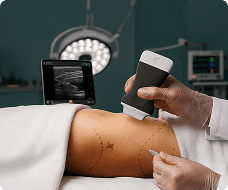
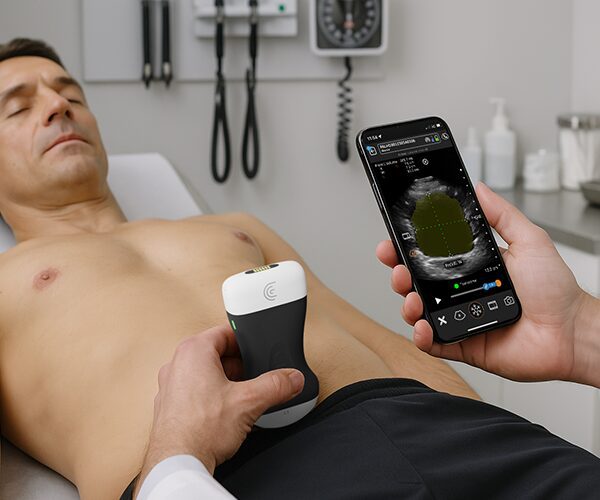
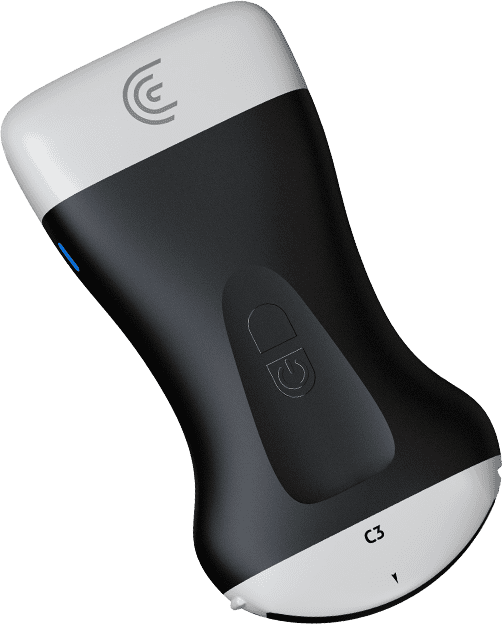
my name is Dr zanab al- mukar I'm here with my lovely patient Sandra who is Keen to have a non-surgical rhinoplasty as with all non-surgical rhinoplasties I first perform safe mapping to ensure that I have preempted the position of the vessels prior to injection in the case of a very high dorsal hump more ultrasound gel is required so the higher the bump the more the need for ultrasound gel this is important when scanning we want to ensure that we're not pressing down too much this then allows for the gel to move away too much and would then require more gel placement throughout if we can hold the probe quite steadily without pressing down too much we can preserve the gel in the position that we want it you can see the gel at the top of the image you can see the hyper coic line which must be very clear at the very base you can see the dermis you should be able to see The Superficial fatty layer and then a hypo eoic area just above the bone that's usually a very thin layer of deep fatty tissue above which there is a very thin layer of muscle we are now scanning in B mode which allows us to just demarcate the layers and I can see a little dark Lumen just in The Superficial fatty layer which may be a vessel but we're going to find out when we switch to color mode color mode indeed the position of that dark Lumen does correlate to the position of this vessel so initially I can see that there is this vessel and I can see that it is above the muscle layer I spend enough time scanning this region to follow the trajectory of this vessel because as we know vessels can be tortuous they can move through different layers and we want to just check what I'm really looking for is whether or not this vessel touches the periosteum because that's the intended position of deposition of filler as I move inferiorly down the nose along the dorsal hump we see that the tissue layers become much thinner we raise the color box and we can see a nice vessel there the intention is to stay in the midline because that is the intended location of injection now what we can see here freeze is the location at which point you can see that the hyper eoic line the bone the nasal bone stops and we have the junction between the bone and the cartilage here unfreeze in this case I don't have any intent to inject that area but I still like to scan the whole length of the nose we are now at the position freeze this is the position at which point the lower lateral cartilage domes are beginning unfreeze what am I scanning for I'm scanning to assess the position of the vessels how deep are they how close are the vessels to the cartilage because the cartilage is the point at which I want to deposit my filler please we can see that there is a vessel fairly deep sitting just above the cartilage as we approach the very tip of the nose the pron I will follow the course of this vessel to decide whether it is safe to inject my ended area of injection is further below this point unfreeze decrease depth freeze we can see the vessel is sitting above the cartilage there is often missing muscle layer in the nasal tip the vessel appears to be in The Superficial fatty layer I'll continue scanning to assess unfreeze freeze just to clarify this is the sagittal view this dark area here in the anic area is the cartilage and this is the hypodermis or The Superficial fibrofatty layer underneath the dermis where we would expect to see the vessel is in this superficial fibrofatty layer underneath the dermis in some people The Vessel will be quite superficial far away from the point of deposition of filler for some people it will sit deeper within that layer close to the cartilage the closer it is to the cartilage the higher the risk of vascular injury this is a really important angle because it allows us to see a little bit more about what's going on with the vessels using the knowledge we have from the scanning of the sagittal and the transverse view we can establish the course of the vessels and the overall depth of the vessels so we gather the information from both views to make decisions what we can see is quite interesting about this particular case is freeze the height of each cartilagenous Dome is quite different on the left cartilagenous Dome we can see a much higher much more differently placed position of the Dome compared to the right hand side which explains the asymmetry that we find and we see in this patient's nose externally the usual position that we want to deposit the filler is right on the cartilage and so I'm scanning to check whether the vessels are sitting in that position power mode before starting this I have already marked with a pen my intended position of injection and therefore I am placing the probe directly on that point I'm now moving my scanner up towards the supertip notch region where you can see that the height of the cartilage looks a little bit more similar and as we go back down towards the pron alley which is the very tip of the nose the Dome changes shape again what we're seeing is that there doesn't seem to be any deep vessel sitting right on the cartilage in the central area of the nasal tip there are on the lateral areas but not in the central area and therefore we can consider injection on the cartilage here okay freeze so do a depth measurement now I have 2 mm on the left Dome 2.8 mm capture that okay then we'll go to the right dome again these are two carcinus domes on the nasal tip they are different left and right so I'm doing the right hand side one now freeze quick depth measurement here on the right hand side right dome we have a distance of 3.3 mm actually it's a little bit longer excuse me 3.7 mm is what we have between the top of the cartilage up to the dermis this means we've got more space to inject on the right dome than we do on the left it's just a point that is important for me as I plan my injection amounts as well as my injection depths of of the needle so I'm happy with all of that now and I'm going to clean this and we can begin treatment so I'm marking between the interanal line this gives me my upper sort of limits in terms of the radics it's a very narrow area that I can inject here okay I have my midline deated always clean lots and little scratch coming I still aspirate presuming that we don't know everything now there's a hard bony stop because I know I'm on periostium I can feel it with the tip of the needle aspirated and then very small micro aloot always slow walking it down again just a little aspirating again and this small micro Alat small micro anat and exit so I'm happy with that projection go to the tip of the nose so before we did the treatment of the nasal tip so far there was an inequality in the height of the two domes where the left Dome was much higher than the right dome having now treated the right dome there are there is an equal height of both which is visible for me at this view um looking from this direction so I'm now happy with the Symmetry I can come back now and project a bit further on both sides keeping in mind that my injections are very much still Central there are two typ any little positions either side of the midline we're not deviating laterally where we saw the vessels on the ultrasound oh my God it's beautiful