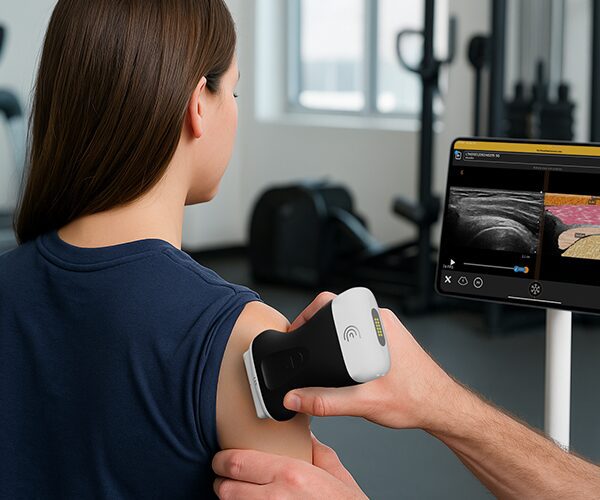
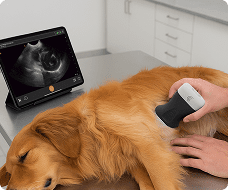
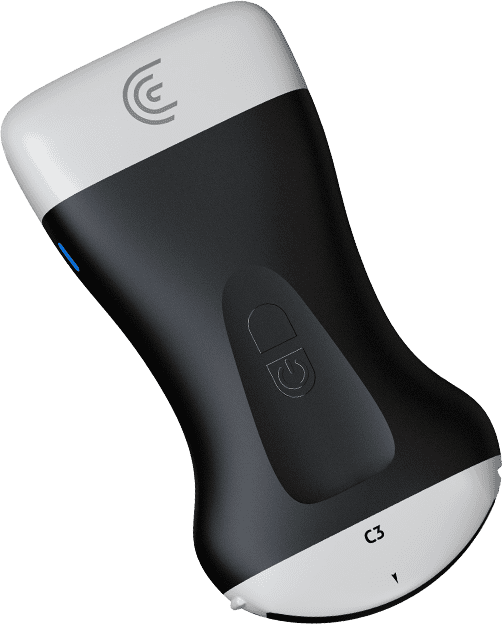
all right everyone welcome back dr boison we are going to start with the sub zyphoid site arguably our most favorite show us how to do it absolutely so let's go into more detail on what we can answer at that subsequent site and how we actually locate that site so the easiest thing to do on this is to make sure you tuck the probe right into the actual v formed where the ribs come together and you see that substitute process so a lot of people when they do the subzyphoid they're a little bit caudal to it you need to tuck the probe as far cranial into that v as you can so trace those ribs down find that spot where you can palpate the subziploid site and then when you've got that site located again we separate the fur we apply alcohol once you can see the skin and then what we're going to do is we're going to place the probe exactly in that sub deploy location we're going to start in this case in long axis again with the marker towards the head that's a beautiful image dr boison so let's go ahead and answer those binary questions first binary question which goes back to the original fast is there abdominal effusion at this site yes or no so dr boison is going to fan that probe really widely in long axis and then we're going to do the same thing in short axis to increase our chances of potentially rolling and rolling out fluid there dr b all right so we've done it long i'm going to flip it into short axis and i can plan all the way cranial and all the way caudal just to make sure i don't have any free fluid when i'm scanning that site so now i'm back in long axis again yeah i'm very important to change the depth here so that you have the entire diaphragm and liver the diaphragm going around the entire liver there so dr bois and i saw the gallbladder there so when we go ahead and answer that question there is there a gallbladder wall halo sign yes or no so we're looking for the thin wall the gallbladder which is normal versus that demandous looking gallbladder absolutely and when we look for that gallbladder it's just the right of midline so you can see that when i've got my probe here straight in on midline at about a 45 degree angle is how we want to look for that gallbladder and assess the subzyphoid site initially for fluid and assess the gallbladder wall the gallbladder sits just to the right of midline she's in the left lateral which means the gallbladder is going to be a little off the table so we're just going to fan the probe to her right and there you can see we pick up that gall bladder really nicely and i look at that dr schlub i see very thin wall i can see that's just barely visible it's a white line that we can see there but it's definitely not thickened and i definitely don't have a halo sign so that's the gallbladder we're going to look for there i'll fan all the way up one side fan off the other side make sure that disappears and we'll come back and do the short axis that the end as well very much dr boison and since we're here i see a beautiful caudal vena cava we're going to ask a question here can we safely give this patient iv fluid bolus yes or no by looking at that codomina cava and look at that change in diameter dr woodson for respiration absolutely so i can see that here in the far field it's at about the 10 centimeter mark you can see that we've got the two parallel lines the near wall and the far wall of the vena cava and it does have a couple of things we look for as you mentioned actually we can see the bounce here so the cardiac pulse that is a normal finding we lose that when they get volume overloaded we can also see that the diameter the distance between the walls of the vena cava gets narrower on inspiration versus expiration and we expect to see at least a 25 change in the diameter of that vena cava at this location and that's basically used for us to determine can we give this patient a fluid bolus is our patient fluid responsive yes or no yep the other thing dr boise we're getting a good look inside the thorax from this site here dr boyzen and we see a perfect mirror image mirror image meaning that we have air on the other side dr poison and we don't see any pleural effusion for instance absolutely so we do look for pleural fusion at this site as well we extend the depth beyond the diaphragm as we've done here and you can see that beautiful mirror image artifact we only see that when there's air on the other side of the diaphragm so at this particular location in this particular plane i can say confidence there is no pleural effusion on the far side of the diaphragm and the distal image because we see that lovely mirror image artifact we also see a b line here dr schlub i'm sorry you mean a lightsaber doctor boyz so we see that vertical white line that's coming off the diaphragm we do look for lung pathology dr lube they look like rays of sunshine coming down from the heavens if you prefer the lightsaber you can use that as well but you can see we got this vertical white line we can't see lung pathology in this case seeing one to three b lines at this location coming up the diaphragm would be normal but if we have increased numbers then that is a concern as well 100 epic jedi fight right there dr boyzen i think i saw the heart come in there for dr boyz and that's another great thing about this subside foot site we can determine really quickly do we have pericardial effusion yes or no arguably better and faster than looking at trans thoracically absolutely coming in and actually come much more to straight midline to a little bit left of inline again the gallbladder to the right of midline so i'm here on the gallbladder i'll just fan down towards the left side of my patient in this case towards the table top based on how penny's positioned and you can see that cardiac blend so we see that left ventricular free wall blending into and uh becoming one with the diaphragm and the liver so we can see that contraction there and this image here i can actually see the left ventricle in its entirety this is a really nice view that we have with the clarius at this site here but all i really need to see to rule out pericardial fusion dr lube is that cardiac blend with that left ventricular free wall is continuous and blends with the soft tissue of the diaphragm in the liver ruled out pericardifusion very quickly nicely done dr okay so some other questions that we can ask your dr boyzen let's go ahead and rock that probe and look at the stomach and we have the stomach here and we can see if there is gastric contractility here yes or no all right so and what we did then is when we're actually looking at the subsurface to assess the heart the gallbladder and the liver you can see i'm at a 45 degree angle here when i want to assess the stomach i know it's caudal to liver so i'm just going to unrock that probe come in more perpendicular and you can see we drop right onto the stomach a penny here now penny has a pretty full stomach that's a large stomach there but if i hold this here long enough right there look at that contraction so we can see that gi motility a wave or a contraction of the stomach and that tells us that in this case we wouldn't be having for example generalized dileus so general idealist is something that we only look for in our post-operative patients and seeing that contraction in the stomach rules out a generalized post-operative illness for example it doesn't assess all sites of the intestine for ileus in all locations but it's a nice spot for us to look for it at the stomach 100 dr poison so if we see you doing break dancing in that stomach we rule out generalized alias now one thing dr boyce and since we're at the heart something a little new dr boyzen we can look for contraction during cpr absolutely so this is another site when you're doing active cpr if our patient was most comfortable in lateral and that's the position that we are doing our cpr i can actually put the probe on at the sub-zephoid i can see the heart here at this sub-zephoid as you see now and we can actually judge the degree of compression during active cpr and when we switch compressors at that two-minute mark we have about a five-second second window i can assess that free wall of the heart right there and say i have ventricular fibration or i have no cardiac activity versus i have cardiac activity so again one more thing we can look for at that subside site that's pretty new but we can assess cardiac activity in our five point a focus exam at this subside location i love it dr boison and let's not forget we do all of this in short axis as well and here we have a big smiley face with the liver on top there that's how we know we have the entire image and we can ask the same question dr boison i love it and that was the subside footsight of the abdominal pocus you