2025.07.10-Vet_The Aspire UCS 8-Step Abdominal Survey - Step 7_v12F.txt
English (US)
00:00:00.040 — 00:01:18.850
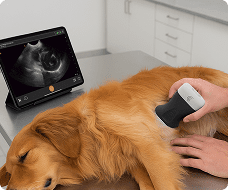
Hi, I'm Angie. This is Julie, and this is little O.t, our doggy model today. So we're going to show you step seven of our aspire UX eight step abdominal ultrasound survey. So what's in step seven? Well we're going to look at the kidney the right adrenal gland. We're going to scan down the right side of the aorta vena cava and hopefully pick up that right medial iliac lymph node.
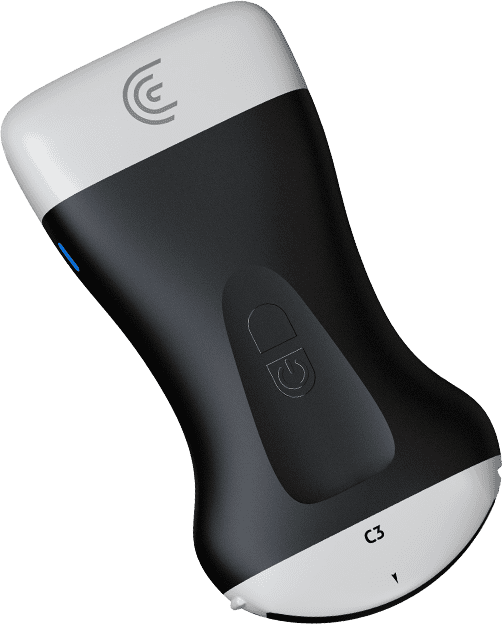
So this is exactly the same as step four which we did from that left lateral approach scanning down towards the table. Now OTT is not sedated today. So balancing a little puppy on a little micro convex probe is not always the most pleasant of feeling. So we'll give it a go. And if she feels that it's a bit too much, then we can stop.
Okay, so make sure you've got plenty of gel on obviously, and check your orientation marker. So we want to have our light towards the head so our orientation marker towards the head. And we're going to start in long axis and locate that right kidney in long axis. Great landmark for identifying right pancreas level of the IC.
Your right adrenal gland, hopefully and obviously for assessing your right kidney and the duodenum. So we're going to go underneath.
00:01:20.050 — 00:01:41.650
And let's just gently wait and get some graded compression on it. Just I know darling. So we're starting to get a kidney coming into view here. Here's our kidney. Good girl. So let's just see if we can go up a little bit on our gain just so that we get a little bit more visibility.
00:01:45.490 — 00:01:47.210
Okay. So we've got
00:01:48.410 — 00:03:15.500
vena cava and aorta. Now if you remember when we were scanning step four, we were coming from this direction. So the top vessel was the aorta. This time we're coming from underneath. So it's the bottom vessel. This time that's going to be the aorta because it's the furthest from the the surface of the probe.
Okay. So here's our aorta. And if you remember from step four, we said that that's the one that will be pulsatile. It will have vessels coming off its slightly thicker wall. If I take the pressure off we open up this squashy vein. Now, this is our little slug sign we talked about in step four. There's our aorta.
These two vessels here are the level that we're expecting to find our right adrenal gland. Now it actually lies in between these two vessels. So as they sort of, um, go down the screen slightly to the left, this girl. So our right adrenal is actually just going to be in here. So it's just a little bit of pressure.
Just try and see if we can get it. Now obviously if you've got a sedated dog then it's going to be much. There we are. This is it. So we'll just go a silly loop back a little bit. So with the eye of faith we can just see our little arrow head shape here. So we're going there to there is how you would measure it just a little bit.
Just adjust it. And there we go 4.1mm for that right? Adrenal.
00:03:16.780 — 00:04:03.540
Now, having found the adrenal gland, I think it's good practice to just carry on scanning down the vessels. So here is our aorta. I'm just flicking my hand back a little bit because that then brings my vessel more horizontal on the screen here as you can see. So that means that the sound is hitting those walls at 90 degrees.
So we get a much sharper area, a much sharper reflection, rather just sliding down towards the bladder area. Now just slowly, slowly doing it. Here we go. We have tri fixation here where it goes into this more tapered area. And we're expecting to see a little lymph node around this area,
00:04:04.860 — 00:04:09.140
just like we did on the other side with Lily when we did step four.
00:04:10.180 — 00:05:22.310
It's just in there with the eye of faith. This little area here just just about see it just here. So again they're not enlarged. They're not abnormal. So I think usually when you struggle to see things then it means that they're much better and more likely to be normal. So let's just have another look just to see.
And of course it's always good to check it in short axis. So there's our try ification. So let's go around. So don't forget the non squashy one is going to be the aorta. That's this one. I'll just take the pressure off and it opens up the vena cava. And just show that press take it off. And of course you could always put a bit of color on if you weren't sure what was what or where they were.
Now it's the real world. None of us can ever get perfect pictures all the time, no matter how long we've been scanning, how good our equipment is, how brilliant our technique is. So, you know, you've seen during our demonstrations that we don't always get the sharpest or clearest of views, but the most important thing is that they look grossly normal now.
00:05:23.520 — 00:06:11.320
when we're scanning, we're using our eight step technique. In the ideal world, we would have patients sedated. But in this case, for example, OT is not sedated. So to look at things like the kidneys you may well need to turn your patient. Same is true for the pylori. So there will be certain structures that sometimes you just need to turn your patient.
If we have a sedated patient then we can usually I would say about 80% to 90% of the time. See all of the scan from the underneath side. But when they're conscious it's not particularly comfortable. So let's have a look at the kidney now. Like a cat he's got quite floppy skin even though she's only a puppy. And you can scan into costly and find locate that kidney.
So it is in here. So this is the kidney.
00:06:13.680 — 00:06:43.090
We're going between rib spaces here because she even though she's a puppy and she's tiny, she's got quite a deep chest. So the kidneys in here, which makes it a little bit trickier to scan. So some people struggle because they think once they've got to that cordon margin, you know, that that kind of costal margin here, that they must have come across the kidney, but they haven't missed it.
It's actually because it's that bit higher. So here is our kidney, our right kidney. If you scan all the way through it and then back the other way,
00:06:44.170 — 00:09:32.460
finding your probe, because you've probably got just a little scan window that is between the rib shadows here and here. So you have to just make do with what you can. So scanning the kidney all the way through from one plane to the other, find the window is a tiny little bit of maneuverability just between those ribs to get the most kidney you can, you know we're getting some cortical medullary differentiation.
We've got nice renal margins around the outside. No hydrogen neurosis, no obvious mass lesion. So we'll probably want to do is just try and find the endpoints the longest axis of that kidney. And again try and rock it so that your kidney is horizontal on the screen if you can. So it's not too bad that not perfect, but it's not too bad.
And again, as I say, it's doing what you can to just try and make sure. So this is where you think, actually I think it's there really hard to if everybody in the, in the department all measured the same kidney, the chances are that you'd all be slightly out because ultrasound it's very hard to standardize these measurements sometimes.
So there's our right kidney. We're going to take a picture of that just to show that we've seen it. We've obviously scanned it in multiple long axis sections because we've gone all the way through it. And there it is again, all the way through and then back. So it doesn't take long before we're through her little kidney.
So there's not a lot of maneuverability. And then I'm going to rotate on it. Always turn counterclockwise. And there I'm going to fit the kidney the round kidney now in between the the ribs. But look here this is loss of contact. So you can either put a bit more gel on okay. So that that helps the situation.
Clip. Yeah. Clip a bit more. Yeah. Or add a bit of spirit. So, um, just be careful to protect your probes if you're using spirit. So scan through the kidney and we're bumping over the ribs to go in short axis. In this particular case there's liver. Beautiful. Liver is a great way to have a look at that caudal margin of the liver through all the way through to the caudal pole.
And this is, of course, where you would find an ovary if we were looking at an entire female, which ot is. And we can just see the ovary down here. So here's our kidney. This is our caudal pole. Let's just find that ovary again. Come back and back. It's in there. Just in there. Yeah. So it's tricky just there because it's not really capsular and it's just in this area here.
So no big massive cysts or anything to worry about there. Okay. And that is step seven.