2025.07.10-Vet_The Aspire UCS 8-Step Abdominal Survey - Step 8_v11F.txt
English (US)
00:00:00.440 — 00:04:06.660
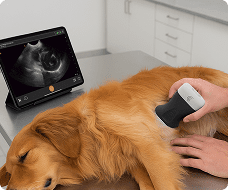
Hi, I'm Angie. This is Julie, and this is Lily lying on the table trying to nap. What we want to show you today is step eight, the final step in our aspire UK's abdominal eight step survey. Now, this step is going to include locating the right kidney. We're going to take the pressure off angle down towards the table, which is where the duodenum will be lying because it's the most lateral part of the small intestines.
We're going to pick up that duodenum in the near field, assess the wall measurements, follow it upwards towards the pie. Laura's all being well, and then down cordially around the duodenal flexure. And then up Cranley, up the ascending duodenum, now attached and running parallel to that descending duodenum is the right limb of pancreas.
So we can use the duodenum to help us find that right pancreas. And most vets struggle with the pancreas and adrenal gland. So hopefully this should give you a little tip on how to locate it with some confidence. And obviously practice is going to make perfect. So whether Lilly lets me do this because she's not sedated, she does look a little bit relaxed and put a little bit of extra gel.
And we're going to start in the long axis section. Now for a lot of the views from the underneath side of the dog, I locate the right kidney and long axis because it's an easy structure to find. And then I work out from there how to locate the duodenum, the right pancreas, the ICC, the adrenal glands, etc. so it's a really good landmark to get used to.
So I'm going to unfreeze and locate that kidney. So here we've got our right kidney here. And you can see if I take the pressure off. You just see my hand come off there. We have a fat angle down towards the table a little bit more horizontal. So press in angle up towards the spine. We have the kidney because obviously that's dorsal.
Take the pressure off and angle down. We pick up the duodenum here and this is the descending duodenum. Now Lilly does have gut problems I'm going to tell you that now. And she has had pancreatitis in the past. And this is her right limb of pancreas here that's running parallel to that descending duodenum.
So you can see it's quite bright. She's had chronic pancreatitis in the past. And she's very bravely letting me have a look at that. So I'm just going to take a picture of that just to show that I've seen that right limb. Now if I go short axis, we should get a nice coffee bean shape, which is our descending duodenum still.
And here we have this bright pancreas that's kind of waving at us a little bit. So an acute pancreatitis is going to be darker hypoxic and enlarged. And a chronic pancreatitis tends to be brighter and small because it's more for browsed. Okay. Now the beautiful thing with the right limb of pancreas as a dog is that you can see that pancreatic or duodenal vessel, which is a good landmark.
Okay. So pancreas, right limb of pancreas. Looked at. Seen. We've come to some sort of conclusion. Let's now have a look at this duodenum. So one of the things you look at all parts of the bowel is the motility where you can particularly the stomach and the small intestines. So we also want to have a look at the wall layers.
So I was talking in previous steps about this dark light dark light appearance. This is the lumen with content in it. This is the mucosa. And then we have sub mucosa muscular which is the thin black layer and the cirrus on the outside. And you can see the peristalsis occurring. So Lily's got inflammatory bowel disease and her bowels are always squelching around I don't think I've ever seen her with an empty stomach.
But what we can do now is we can actually come back, find a nice, clear section of the wall. And then we're going to measure it just to check out on that wall thickness
00:04:07.780 — 00:05:49.859
with our caliper. So we would measure from the inside lumen so that white black white interface. And then outside. And it's 4.7. And that would be a nice normal measurement for the duodenum. And would take an image representative to prove that we've looked at it. And now when we're looking at this wall, it's quite um, important to be assessing the characteristic layers to make sure there's no loss of that normal architecture.
Sometimes with severe inflammatory bowel disease or pancreatitis, you can get stippling or striations in that mucosa, which can suggest that lymph function or inflammation of the bowel. So once we've looked at the duodenum we've located it from the kidney. We want to make sure that you are definitely on the duodenal.
And I know that because we've seen the pancreas attached to it or very close to it, but I would ideally try and follow this up into the stomach, which she might not let me do. There's our stomach here, so if we try and follow it back down to the there's the pillar is just about coming in here and then round and joining up here.
So it goes round the bend. Okay. So if you can connect this upwards to the stomach then you know that you must have been on the descending duodenum. So we're just going to slide down that. Now I'm taking the pressure off. And that just sort of opens everything up a little bit. Follow it down. Off we go. Down down down.
And in a minute we're going to go round a bend. So this is it around the bend. So it goes short axis pressing in a little bit. And then it's going to go long again here. And then we're going to go just dorsal
00:05:51.060 — 00:08:56.310
just here underneath the colon. And there it is coming up the other end and up towards the jejunum. So that's a great way to be able to be convinced that you have seen all of the duodenum. Of course, you can look at it in short axis as well. So let's find it again. Here's our kidney. Take the pressure off and go down.
There we go. So it's the most lateral aspect. And let's see if we can follow that down in short axis down down down down down down down down. And make it a little bit bigger. Down. Round the bend here. Over here. It's going all the way over here. So if you've ever had one of those toys that's a wire that buzzes.
If you touch the sides when you were a kid, then that's the same technique. And then we follow it up the other side. Good. So that's how you'd scan the duodenum. Now to look at the jejunum. There's so much of it that it's really hard. I'd say it's nigh on impossible, even when it's distended, to follow the whole of that bowel from start to finish, from that proximal jejunum all the way around to that ileum.
So what I tend to do is develop a lawn mower kind of approach to the ventral aspect of the abdomen, so it would start in long axis. Obviously, as we've done with all the other structures, we're going to make sure we've got plenty of gel on the probe because we're going to adopt a kind of hashtag appearance of the front of this abdomen.
So in the long axis, what I want to do, I'm going to just go down on the depth because we're interested now in these midgut little coffee bean shapes. And she's very gassy. So we just you can see here we've got some small intestines. But that's probably so these little smaller loops are judging them. And we're just scanning all the way across the front and then moving slightly down Cordele and then coming across the other side.
And the reason for doing this is I want to just make sure that there are no obvious distended areas, focal thickening, abnormal masses, any lymph nodes that are abnormal. So we're scanning all the way across in a systematic manner, as if you were mowing the front lawn in your garden. Okay, so by going all the way through, we're looking at all these tiny little coffee bean shapes.
Sometimes they go long axis, sometimes the short axis, depending on the lie. As we bring our probe across them. So then what we're going to do once we've gone from cranial to Cordele going left to right and long axis, we're going to rotate the probe this time, start on the right. And now I'm going to go up and down in short axes.
So this way we're actually scanning every little bit of bowel in more than one plane. There's her massive stomach again coming down all the way down the front. Now scanning. See lots of these. And I'd always take some representative images to show that we've had a good look at that midgut section, and we've gone deep.
Now, if you had a case with free fluid, we're looking for free fluid interspersed in between this bowel.
00:08:58.120 — 00:09:44.360
We're coming all the way down and again down that left flank. So still intestines going on here. And we're just having a good look. So it's a holistic approach at the small intestine. Now obviously if you come across any focal distension or abnormality or wall thickening then that needs further interrogation.
Sometimes you can look at the portal vein and conduct as well from this side. Yeah, true. Whether or not we get the chance to do that, let's have a go. So I actually prefer it sometimes as well, especially if the dog is stated. It's often easier. So if I'm just going to press, just go down a little bit on your depth.
And what we're seeing here is we're seeing the portal vein here. Now the portal vein. Unlike let me just try and get a nice image of it.
00:09:45.400 — 00:12:27.490
So unlike the hepatic veins, it has a much brighter, thicker wall than the normal hepatic vein. So this is how you can distinguish it. Obviously it's the it's a vessel that takes. I think it's about 80% of the blood flow into the liver, and the hepatic artery takes the remainder. So it's quite a big vessel.
It's good to know that the directional flow of it. And usually when you're using pulse wave Doppler, you want to be looking at something between 10 and 25cm per second. It's kind of the normal range, anything less than ten. And you need to start thinking about portal hypertension. So the diameter again is something that you might need to pay attention to if you're worrying about shunting, because often that's very small.
And it can even be mistaken for a common duct if there's a big shunting vessel outside the liver. So part of step eight includes the portal vein and common duct, particularly if you've struggled to see that from the ventral approach when you're scanning step one, which includes the liver and the gallbladder.
Now, commonly I would prefer to scan from underneath with the dog in the right lateral incumbency, scanning up underneath from step eight as we're going to show on Oti here. But Oti is lying nice and peacefully on our left side. So we're going to demonstrate essentially the same technique and what we want to be seeing on the screen.
So if we start in long axis and we identify the gallbladder here we have a lovely normal well distended gallbladder. And let's just enlarge it. There's our stomach okay. And what would ideally want to do is looking at the gallbladder wall. We want to try and see if we can follow the neck of the gallbladder out.
So you can just see the neck here. Oh she's breathing which is good. So just there we just start to go into the cystic duct and just see here a second just there. So the beauty of having a skinny loop is we're seeing most of the gallbladder in its entirety here. There's no peri curling fluid, no thickening of the walls, no filling defects of any sort.
It's really important to try and interrogate the neck of the gallbladder, because that is where you can have pathology, or you can have little stones or masses that can cause, um, cholecystitis and cholecystitis. So the cystic duct is basically a continuation of the gallbladder neck just there. So this here it's a tiny little bit
00:12:28.970 — 00:12:32.650
backwards and forwards. So there's our gallbladder going into the neck.
00:12:34.890 — 00:14:40.140
Just there. So this is actually cystic duct here. Now obviously the cystic duck then leads into the common duct. Um so if you have a cat for example it's jaundice. It's really important. Well any dog or cat to follow that duct as far as you can towards the duodenal papilla. So in this same region here now what we have here is we have the neck that actually goes into the cystic duct.
There's our portal vein coming in below here. Just try and get a nicer view of it. There's our portal vein. There we go. And what we have following along there will be our common duct, which is just here. Just there. Just freezer. Sydney, loop back again. She's just having a little wriggle. So it's important to assess this.
Measure the intra luminal diameter to make sure that there's no dilatation. And if you have got a very wide tube there that's running parallel to your portal vein, then that would raise suspicion that there may be some obstruction further down distally. So it's important to check that duodenal papilla area and look at that common duct in its entirety.
So if we were to measure this again we would just want to measure inside the lumen. So there to there and just inside beautiful. And again take a representative images. So what we would want to do then is if we can't see that from this plane or in this particular view, we could look at this. Check this out when we look at the underside later in step eight.
So now let's have a look at the portal vein. So it's important to not confuse the portal vein with the caudal vena cava. Um and there we have our portal vein here coming in. So the caudal vena cava is lower down then it's the aorta. So there's different levels as you scan from down the table up towards the ceiling.
And that's how I check it out. Um there we go. So there's our nice little common duct with our portal vein. And let's just see if we can put a bit of color on it, just to show whether that is the portal vein. And there we go. There's our portal vein here.
00:14:42.420 — 00:14:48.100
This one here. So this is the vena cava and there's our portal vein. So we mustn't confuse the two.