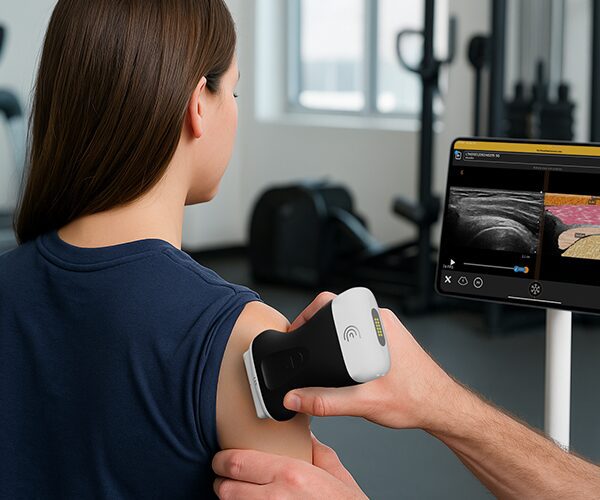
hi i'm greg fritz a doctor of physical therapy and a specialist in ultrasound musculoskeletal ultrasound imaging i am grateful to have with me here today abigail abigail has had ongoing discomfort and has been having physical therapy for your shoulder for the last several months is that right what we're attempting to do is provide for my colleagues some refinements on what i'm able to see to see if we can't have a better focus or a more relevant focus on the pathology that's there this is your biceps tendon that biceps tendon is going to come up go over the top of the shoulder and turn just a little bit i'm going to have you raise your chest up just a little bit higher good and i'm trying to look to make sure that that tendon doesn't have a tear in it actually looks just fine and i'm going to now ask you to keep your elbow to your side and just turn your hand out a little bit like that i'm going to look for the first of the rotator cuff tendons that's the subscapularis tendon coming across right through here it's intact and showing me no evidence of any problem we're going to come sideways to that come along nice and healthy i'm going to now come down and take a look at a little bone called the coracoid i'm going to look across to the acromion we're going to see that that coracoacromial ligament is intact and healthy then i'm going to look down to a little different structure that's called your coraco humeral ligament one of the things that i'm sure terry probably told you is that we had a concern that we could be dealing with something called frozen shoulder or adhesive capsulitis and one of the things that we have the ability to do just really quickly is measure because one of the indicators of frozen shoulder is this being larger this particular ligament being larger than about 1.8 the next thing i'm going to have you do now is take this hand and place it flat on your buttocks cheek as far back as you can good just like that and bring your elbow across and your chest up nice and high for me is that hurting to do that no i'm gonna do a little bit of a scan here this again is your long head of the biceps this is your subscapularis tendon and we're looking at the supraspinatus tendon here the next thing i'm going to look at is this little dark area up at the top here that's a bursa and so when a person has bursitis that means that there is fluid that allows me to see a black line over the top of the rotator cuff what i can tell you right now is there's just a little bit of a a small little bony defect right here what that shows is that in the process of the injury that you probably had where you pulled extra hard it pulled up a little bit of bone where it was attached into the actual anchor point i'm going to bring your arm across like this just like that i'm going to now go to the back of the shoulder i need to go a little bit deeper i'm sorry about my hand in your face there so what i am going to have you do i'll take this arm and we're going to look at that and go across here and out like that and bring it across and out and i'm going to have you lift that arm forward now go ahead and bring it up okay and then back down and then in just a second i'm going to turn it here and i'm going to have you lift it up yep just like that and then back down [Music] so in summary after we've done the scan to abigail's shoulder there's clear evidence that we have a subacromial subdeltoid bursopathy or a condition like a blister that occurs between one surface and the other creating bursitis we know that because there's a black line between her rotator cuff and the acromion in addition measuring the coraco humeral ligament and seeing that it was about 25 to 30 percent larger maybe even 50 percent larger than it should have been this all comes into play in saying i can confirm that we are in most likely the freezing hopefully maturing phase of frozen shoulder one of the final things to conclude is that with the dynamic movement either in forward flexion and abduction the humeral head itself did not drop like it should but in fact just simply rode up and when we did internal and external rotation the middle facet did not come around to the seven o'clock position that it should in order to document normal movement all of this is to say that there are clear directions that we can take her physical therapy care refined by the fact that i am 100 certain there is no rotator cuff tear you