2025.07.10-Vet_The Aspire UCS 8-Step Abdominal Survey - Step 5_v9F.txt
English (US)
00:00:00.120 — 00:07:27.190
Okay. So now we're going to scan this step five of our eight step technique. And this is going to include the urinary bladder. Now if we have a male patient then we should be able to locate the prostate gland and be able to assess that by following the neck of the bladder accordingly. Obviously if we've got a non neutered female patient then we should be able to see the uterus and follow that cranial towards the ovaries.
Now we want to scan the bladder in its entirety in both long and short axis. And then behind or dorsal to that bladder on the screen we'll be able to pick up the colon, the descending colon. And we can follow that retrograde all the way around towards the cranial aspect where we see the spleen. We go past the kidney, and then we can follow that into the transverse colon and sometimes all the way around to the IC.
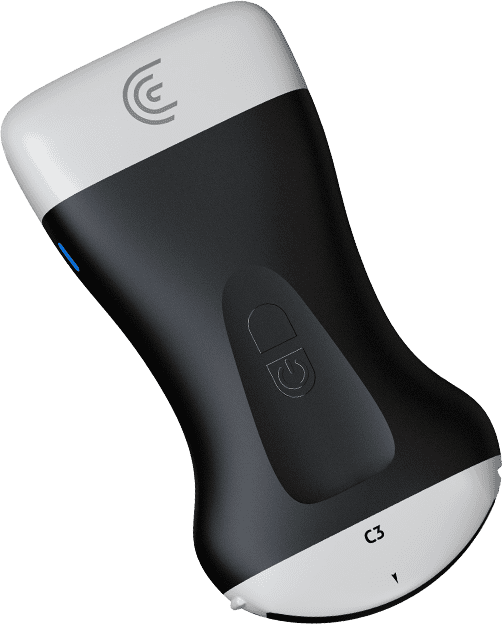
But if not, we've got another step where we can tackle that. So let's start by scanning in long axis section again. So we want our orientation marker towards the patient's head. And as you know by now that correlates with the little icon on the left of the screen, where the first crystals are fired from when building a frame.
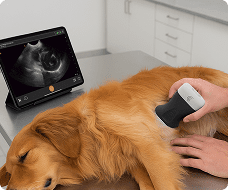
So always starting long axis, we're going to locate the bladder, so we put the probe on. Identify the bladder here. Let's just have a look and see if we need to do any adjustments to the begin. There we go. So by just reducing a little bit we can. Particularly if you've got a TGC and the Clarice does have a t GC, you can actually make sure that you haven't included any artifacts like reverberation artifacts that you might misinterpret for bladder wall thickening.
So there's our bladder in long axis. If I follow it cordially between her legs and pointing down towards the table, it will go into a little beaky area here. Now this here is the urethra. Now, if we were to follow this in a male dog, this would lead us to the prostate gland. We'd have a lobe either side here, which would be allowed to able to assess in its entirety.
So in short axis, if we turn on that, that there is our urethra. That tiny little dark structure there in the center of the screen. Go back to long axis. Now it's very important if you have a patient that has Euro at all to follow that, because the odd time I've been caught out, there may well be stones in the urethra and particularly the penile urethra in a male patient.
So let's have a look at the bladder. So how do we assess it. So we're looking at the wall. We're looking at its regularity the thickness the mucosal surface the inner luminal surface. Making sure that there's no obvious focal areas of thickening. That might suggest that there's a tumor there. Obviously, if we've got clumped debris, we want to be able to blot the bladder.
So we'd do this from underneath, and we would keep the probe on the top of the dog still and just jiggle that way. And then often we'll see tiny little flecks that are suspended within the urine pool moving. So I would always scan towards myself in long axis run out of the bladder. As we've been saying, for all the other structures we've looked at in the other steps, carry on going away from myself towards jewels now in long axis and have run out of bladder and have come into colon territory.
Here you can see the gas come back to the sort of the midpoint of the bladder, and then I'm going to freeze that, and then I'm going to measure the bladder wall. So I do this routinely. And it just helps me get the confidence that that bladder wall is nice and uniform and thin. And it's within the normal thickness limits for its fill status.
I think it's important to remember though, the bladder wall can look thickened if the bladder isn't distended. Absolutely. So that's something you don't want to overcall I think. Yeah. And it's a muscle at the end of the day. So it contracts doesn't it. So it becomes thicker when it contracts. So now we're going to have a look at the bladder in short axis.
So I'm going to rotate my probe towards me. So always counterclockwise to go from long to short. And we can see here our bladder nice and anechoic. There's our colon around about sort of 3:00 on the screen. And I'm going to scan Cranley now all the way through the bladder until we run out. And we're going to come back down and we should go into the urethra.
Now Lilly's been spayed, so there's not going to be any uterus to look for there. So whenever we have a female entire patient and we have a lovely full bladder like we have here with OT, it's important to check out the uterus to make sure that there are no issues there. And obviously if you are querying whether or not there's a Pio or any kind of reproductive problem going on, then you need to be able to find and assess this area.
So the uterine body you can see here in short axis section there's the bladder here is lying just behind the bladder and adjacent to the colon. So if we follow this up in short axis, we should at some point see in a minute that it's going to just just go into one of the uterine two uterine horns here. So they're a little bit skinny because she's nice and young and she's a puppy and she's not been in season yet.
And here we can see the two uterine horns. If we follow them back down again they start to join up right there with the uterus. Here we go. So again look at it in long axis. We look at everything in more than one plane. So this here is our uterus. Here you can actually almost see the uterine endometrial cavity in between there.
And you are seeing this behind and now dorsal to that bladder. So it's important to check the uterus in an entire female just to make sure that that's not the source of infection or a problem that you're having with your patient. So we've scanned the bladder in its entirety in long and short axis. Now we're going to follow the colon.
So pick the colon up in that. It's around about 3:00 in this image because she's got she's not got a very well distended bladder. It's not long been to the toilet. So sometimes it's round here about 4:00. It's 3:00 here in this relatively empty bladder. So what I'm going to do is follow the colon up in short axis.
So I'm sliding all the way up the patient. Now sort of that sort of dorsal approach. Because don't forget the colon is quite dorsal within the body. You can adjust your depth. You can scan at the colon. That's it. Nice. Yeah. So there's the colon wall. You get to see that characteristic or layering of white black white black.
But also as we come up we start to see kidney coming in. So we know that we're coming to round about that flexure area. And I'm now just having to work my way around the colon. Here is the colon comes across the front of her and I'm just going to adjust my depth again. Oops. There we go. This is it. Try not to lose it and then follow it around here.
This is colon. This is colon. So this is coming along the front of her tummy. I know to where in a cat you can quite easily pick up the IC, CJ or the ICJ rather in that section. So we've come all the way round the colon across the transverse colon and toward the cecum area. Now, if we don't see that junction between the ileum and the cecum and the colon, then we can find that from underneath in one of our other steps.
So Lily, thank you for that.