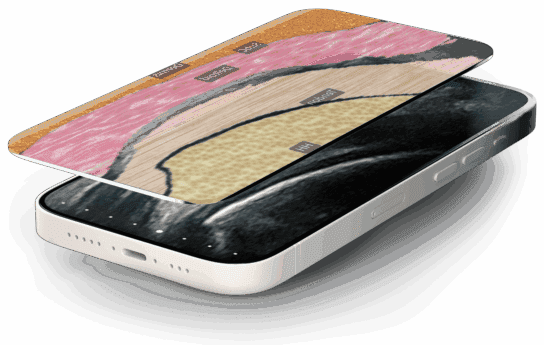
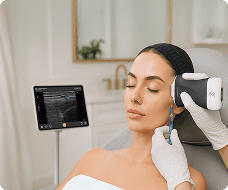
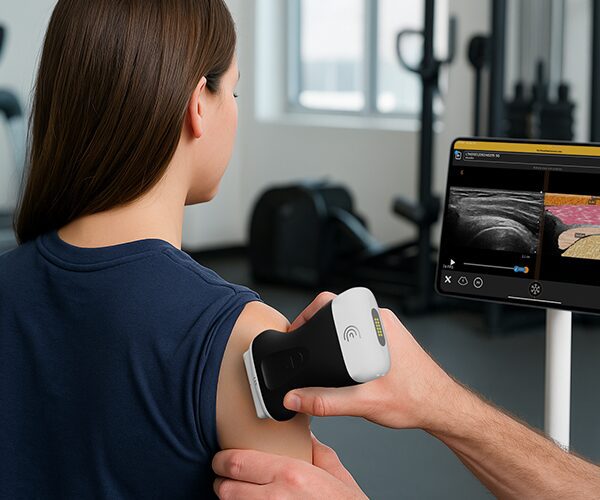
The next area evaluation is the forehead. And the forehead anatomy is not that complex. So let's take a peek here. I'm using a preset for the forehead and temple and have the patient elevate the forehead if you can. This patient has to talk in it, so it's a little bit tough, but you can see all the anatomy here. So the deepest area here is going to be your bone. What you see down here is called mirror artifact and it doesn't represent real anatomy. So then we come up here and we see the muscle. It's a little bit hard to see, but it's a thin layer of muscle. And that explains why hitting the frontalus muscle is somewhat difficult sometimes because you can see on either side of it is the galia. It's a fascial layer of that muscle. So unless you get pretty accurate with your toxin, it's conceivable that the toxin isn't hitting the muscle just right. And that's why at least one of the reasons why the frontalus is the most difficult area to treat I feel for toxins below the muscle is going to be a fat pad and superficial to the muscle is also going to be fat pad. Keep in mind that as you go more superior in the forehead that the muscle becomes closer and closer to bone and gets a little deeper. So in this particular area here um there is a fat pad called the roof which is a fat pad that's behind the avicularis oculi muscle. Let's see if we can see it maybe a little bit better. So this is going to be your roof right here. retrovicularis oculi fat pad and just superficial to that is going to be your muscle. So keep in mind that distance from the muscle to the bone and then I'm going to go more superiorly and let's take a look at up here and you're going to find that the muscle is very close to the bone up here. Relax. And I know it's a little bit difficult to see, but the muscle is basically lying on the bone right here. So your injections in the superior forehead need to be a lot deeper than your inferior forehead. So this is another good evaluation of the anatomy of the forehead. So here you have the bone. Here's mirror artifact down here. Here's a deep fat pad. And then here you see the muscle which is going to be this dark gray almost black structure. So it's going to be hypoacoic technically but it looks almost anooic. And then on either side you see a fascial layer. There's a superficial and a deep fascial layer. When you combine the fascial layers with the muscle, it's called the galia. It's actually quite difficult to penetrate. So that's why these injections are quite difficult in the forehead. And then you see a superficial layer of fat and you see the dermis up here. So if you look at the dermis, there's actually three layers to the dermis. Let me see if I can make that a little bit bigger. So now let's look at the dermis. So the most superficial layer of the dermis is going to be epidermis. Um the next layer right here is going to be your papillary dermis. So the papillary dermis is going to be a a rather dark gray. Why is it that color? Why is it hypocoic? It's because there's a lot of vascule in the papillary dermis. If you go deeper into the dermis, you see the reticular dermis right here. The reticular dermis has a lot of collagen and elastin. So, it's going to be a little different echo. It's going to be more bright because we know that collagen is going to be hyperacolic. And then below right here, that's your subcutaneous fat. And you see again the superficial and deep fascia and then a muscle sandwiched in between with the bone right here. So that concludes the anatomy of the forehead.