



Calculate your ROI Today
Enter your email to access our ROI calculator and instantly see how much revenue your clinic could generate based on your pricing and volume.
By providing my email, I consent to receive Clarius webinar invitations, case studies, whitepapers, and more, and I consent to the Clarius Privacy Policy. I can unsubscribe anytime.
Real Results. Real Impact.
Learn how these aesthetics practices make ultrasound pay off clinically and financially. Download the full case study to see their before-and-after comparison, implementation strategies, and proven return on investment for their patients and business.
Meet the Innovators

Laura Osterweil, PA-C
Erasable MedSpa
20+ years of experience, background in interventional radiology, and a passion for aesthetics.

Michael Zanetti
Erasable MedSpa
Chairman of Erasable MedSpa, Co-Chair of AmSpa Florida, and former U.S. Army Major bringing strategic business insights to aesthetic medicine.

Dr. Jordan Atkinson, ND
Akin Skin Aesthetics
12+ years of injecting experience, educator, and advocate for patient safety. Founder and owner of Akin Skin Aesthetics.
Inside This Case Study
The Challenge: As aesthetic procedures boom, with hyaluronic acid (HA) fillers up 56.4% in the four years, practitioners face an inevitable reality: injection complications. Erasable MedSpa and Dr. Atkinson recognized that traditional approaches meant either waiting (risking necrosis) or unnecessarily dissolving filler (losing patient trust). They needed a better solution.
Dr. Jordan Atkinson, ND: “If you’re not using an ultrasound for complication management, you just can’t get inside of a nodule, it won’t dissolve if you flood the area.”
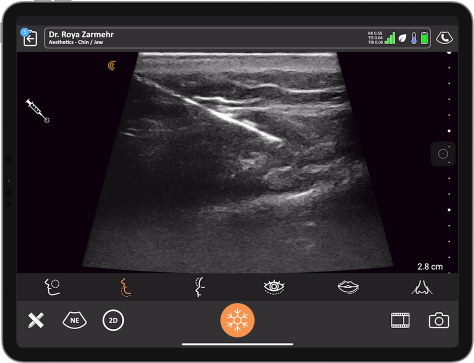
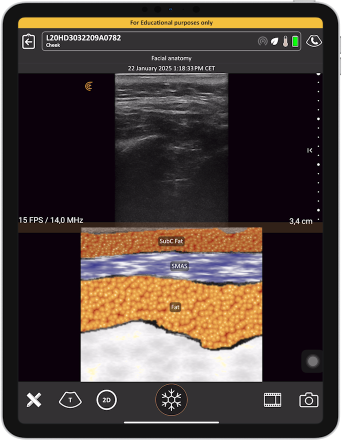
The Journey: This case study chronicles their complete ultrasound adoption, from initial equipment research and team training (starting from zero experience) to daily workflow integration. You’ll discover how they practiced with their patients, created standard operating procedures (SOPs) for their teams, chose portable technology, and gradually expanded from complication management to routine assessments and patient screening for high-risk procedures.
Mr. Michael Zanetti: ‘We chose to invest early in ultrasound, driven by a commitment to predictable outcomes and evidence-based protocols rather than trends.’
Laura Osterweil, PA-C: ‘Combines her passion for imaging with her work in aesthetics. Ultrasound is a way to enhance safety and deliver superior results.’
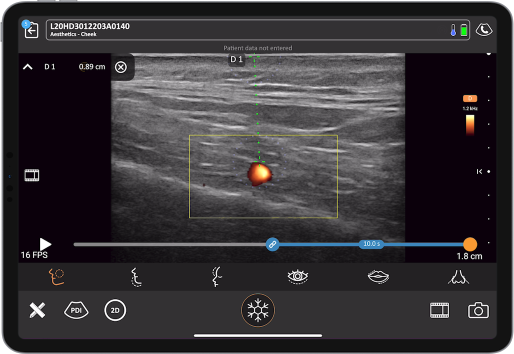
The Transformation: Both practices now use ultrasound to map unique patient anatomy (the angular artery is absent in one-third of the population)1, assess new patients, manage complications, and create premium patient experiences. The results: better outcomes, reduced product waste, new revenue streams, and practices that stand out in competitive markets.
Dr. Jordan Atkinson, ND: “I honestly think it’s going to be in every single clinic. It’s going to be just the norm to have an ultrasound machine in your office.”
Book a Virtual Demo
Powered by Clarius Intelligence with specialized presets and customizable workflows, Clarius HD3 automatically optimizes imaging to deliver a superior ultrasound scanning experience. Book a virtual demo with our experts to learn which scanner can deliver the best ultrasound imaging for your practice.
By providing my email, I consent to receive Clarius webinar invitations, case studies, whitepapers, and more, and I consent to the Clarius Privacy Policy. I can unsubscribe anytime.