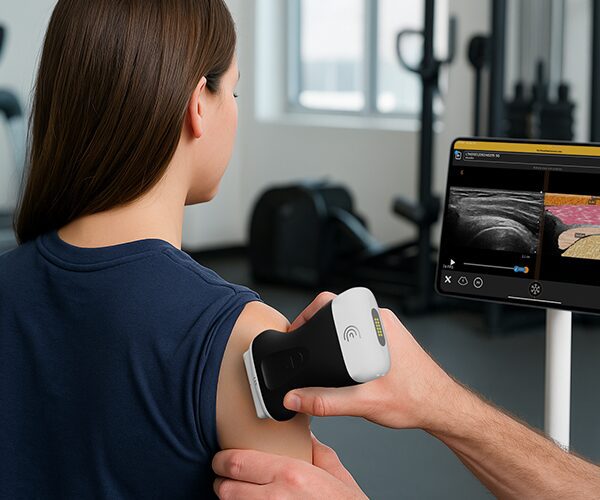
in the next video I'm going to show you the AC joint and also looking at the infraspinatus Terrace Miner and dorsal glenohumeral joint patient is still seated upright sitting on a stool basing the transducer over the AC joint connecting the clavicle with the acromial bone like this and what we will do is we're going to first check the AC joint statically so sweeping the transducer from ventral to a dorsal looking at the bone regularity and also how the capsule thicknesses and whether we see effusions from a traumatic perspective we can also look at joint width the height of the clavicular in relation to the acromial bone as if there is a huge difference then it might indicate ligamentous injury so after I've scanned it with the patient statically then we're going to ask the patient to move dynamically by making a movement across our maneuver which is from this location to the other shoulder and then totally back and at this location the patient needs to relax fully and what we're going to assess is the stability of the AC joint so do the two bones stay together so let's do that by making this movement okay so you can move your hand to the other shoulder all right good and go back please to your leg and at the end please fully relax okay so we don't see any change in the bone and that is a good thing because with an instability you would have seen a large drop of the clavicular then we're going to check the infraspinatus tendon and teres minor so we're going to rotate the model a little bit and then I'm going to place the transducer on the insertion to the greater tubercle and now we can see the insertion of the infraspinatus with on top of it the subacromial sub deltoid Burson and we're going to slightly transducer to distals to also check the Terrace minor tendon after we have checked this insertion we're going to follow the tendons towards the human head and Beyond to the muscular tenderness Junction right here and even further to the posterior joints right there now we can see the glino humeral capsule attached to the labrum and that is attached to the glenoid cavity which is the lowest bone scene and screen overlying is the infraspinatus muscle and the hypercoic infraspinatus tenderness opener hoses so let's have a look at the external internal rotation we look at the movement of the labrum how that one behaves but also for fluid accumulation in the in the joint capsule and the posterior recess and see whether the labrum stays in the same spot after having checked the labrum and the joint we all can move a little bit further to search for the spinaglina notch now the deepest in screen four centimeter of depth and we're going to make an external rotation to see whether we can see fluid collections accumulated around the nerve the suprascapular nerve and screen for a nerve entrapment now we can see the vein opening and closing with with making this external rotation but that's a normal finding if you see a fluid then this anechoic Mass stays there whether you internally or externally rotate then once again going to the infraspinatus and then insertion and following in transverse view the infraspinatus to the tendon to the muscle belly right here now we can see the infraspinatus muscle belly and once again what we will do is check the infraspinatus muscle search or assess the echogenicity and we compare it with the overlying deltoid muscle and this echogenicity should be fairly the same you can see the internal up in the Roses very well so this is also a sign of a healthy muscle and we're going to ask the patient again for a contraction so you can push there yes and relax once again yes and relax okay so this is also a healthy muscle