2025.07.10-Vet_The Aspire UCS 8-Step Abdominal Survey - Step 6_v5F.txt
English (US)
00:00:00.400 — 00:04:21.919
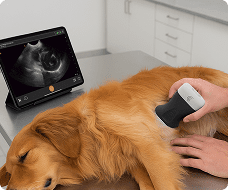
Hi, I'm Angie Lloyd-Jones. This is Julie, and together we represent aspire UX. And this is our little puppy model Oti, who's here to help us talk through step six of our aspire eight step abdominal survey. Now, step six is all about covering the colon. Any sections of the colon that we didn't view in the views and the planes that we wanted to from that left lateral approach during step five.
So the ICJ or ICJ is a really important area to locate. And in cats, it's quite easy to find that and follow the colon along from posterior to the bladder, up the descending colon, across the transverse, down the ascending to that region in a cat much easier than it is in a dog. So often we need to have a different approach to that area by scanning from the underside of the patient.
So what we're going to do is we're going to try and scan the whole colon, including what we've seen in step five, just to reiterate that. So let's pop some gel on Oti. She needs to come a little bit further forward. This way. You're just falling off that hump sick again. So she's had a little clip. So there's the gel.
I'm just going to leave that there for a second okay. So now we're going to start the scan. So if you remember in step five what we wanted to do is we wanted to locate the bladder from that left lateral approach. So here is oats bladder. It's not massively full taking the pressure off and adjusting the depth here.
I'm also going to take the auto optimization off because I like to be able to optimize the controls independently. So I'm just going to reduce that slightly and now change the depth. And here we have our bladder on the screen. Now at around about 3:00 4:00 we can see the gas in the colon here. And this is the colon.
This is the part that we actually want to trace all the way along. So we're going backwards along the colon. So starting here there's far distally as you can get. There's only a little uterus and cross section and colon. And now I'm going to start scanning upwards following the colon in short axis. Now why is this important.
Because if there is gas in that colon as there is here, we can see around three sides of that colon when we look at it in short axis, if we rotate and try and follow it up in long axis, then we don't see any of the tissue behind that colon because the air is our enemy and it stops the passage of that sound and we get this dirty shadow.
So hopefully if we follow it up in short axis, we should see any lymphadenopathy on route as well. So here we go. We're sliding up and just tend to try and keep your finger on where it is that you're looking at or going all the way up. Let's keep up. Leg there okay. Up towards the spleens just coming into view.
now has a kidney. Here you can see the kidney. So we're at the top of the descending colon. We're going across the transverse colon now. And we are just following this. And it should take us just in front of the stomach here. So I'm going to adjust my depth. This is colon. This is Otis Tommy with some injector in it.
There's the spleen. So as we come along keep coming across the midline. Just need to apply a little bit of pressure. I know, little one I know. So this is pretty much the midline now. And I'm not getting the greatest view of this Ikeja region. So we're going to try and scan from underneath. Okay. So the way in which we would locate the ICJ from the underside is to locate that that right kidney, the one on the on the lying on the table.
Okay. So in OT is not sedated. So I don't want to press too hard. But her right kidney is down. Just coming into view. There at the bottom you can just see that right kidney. And I'm going to angle up at the level of the kidney. Keep going up up up up up through the duodenum until we find this little bit of colon.
Here I'm just going to look like she's wiggling a little bit
00:04:23.120 — 00:04:41.880
just here. So this here is our IIC. So I'm just going to point it out on the screen. So don't move Oti. So there is our colon our ascending colon. And it's actually going in to oh it's just going into that little ileum there. And I'll just
00:04:43.000 — 00:05:39.570
repeat that. Just that little area there just so that you can see that ilium in view there. So this is where her ECG is. Um, so again one of the things that's important to look at is to look for lymph nodes in this area, because they can indicate that there's local disease processes or inflammation or reaction going on.
And then bear in mind that sometimes if you catch it at the right angle, the ICJ can look a bit like an interception. So don't overcall that. Try and look in both long and short planes, which I'm not going to get the pleasure of doing with OG here because she is a bit uncomfortable. So I'm just going to take the pressure of and this is the area down here that we're looking at this little bit here.
So the comments come around and into the ilium there with the gas.
00:05:40.730 — 00:05:54.250
And that's how you can find your IC from the underneath side in step six. Now if you have a cat, as I say, scan ventrally and practice on the cats because they're much easier.