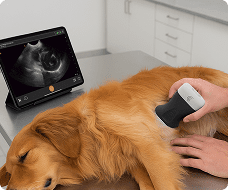
hello everyone and welcome back I'm Serge and I'm CERN and now we're going to be talking about plural space and lung ultrasound plus one of the coolest things I love the post spacing lung it has to be my favorite thing to scan just because there are so few things in the thorax that we can look for but to be able to scan a post Basin lung we're going to show you a quick overview in Daisy here on how quickly we can scan the lungs but before we do that it's really important to know your borders your sonographically defined borders because looking at Daisy here I can't tell where her lung ends and her abdomen starts she's well conditioned Daisy so we can't really always tell where we're going to scan onto the lumbar muscles and so therefore we're going to quickly go over the borders that we scan and then we'll actually show you how we find those and how we quickly do an overview before we break it down and go specifically into each of the pathologies we look for with our plus scanning that's right and we're going to show you where we start with the probe as well again using those borders and all the pathologies we're going to be looking for we're going to go border to order to border to border no memorizing ribs no counting ribs no memorizing any protocols just using clinical knowledge and therefore that first border we're going to talk about is right behind this front limb so if I can palpate the front limb and then I can feel a rib space behind that front limb that is essentially going to be our cranial border and if we lift the limb forward or pull the limb out a little and Tuck the probe into the axilla we can expand that cranial border but essentially that cranial border is as far forward as we can scan with our probe before we hit the scapula and the flexor muscles of the shoulder so that's our cranial border that's right then we have our dorsal border again we're going to be finding these using ultrasound dorsal border that's going to be the end of the plural space in lung we're going to get into the hypaxial muscles so we're going to know that pretty quickly and if we place our probe out that cranial border and slide straight caudal some point we're going to slide off long I'm going to hit the abdomen that's very very difficult to predict and it can vary depending on pathology breed species so we really like to use our borders start over along behind the front limb and slide caudal until you see the vertical Edge artifact with which is the curtain sign transitioning from the lung onto soft tissues the abdomen that's right and then eventually we actually have two borders we have the ventral lung border and the ventral plural border ventral blural border is going to be along that those Turtle muscles down there and the sternum and then we have the cardiac Notch which is very important because that's going to be your ventral lung border so you got to think about those all right so we'll just do a quick overview then we'll show you how quickly we can scan the uh the plural space and lungs in our volunteer here Daisy so again when do we start we want to put the marker of the probe towards the head and we probably want to set our depth usually to set around four or six centimeters to start with and we will use some of the voice command features when we demonstrate this just to show you how we can change the gain and the depth if it's not perfect without having to leave the cat or to reach over and make those adjustments so we're going to go ahead and start again in that cranial border so this is uh how Daisy appears to be most comfortable so I'm just going to palpate that front limb I'm going to separate the fur there so I can see the skin in and I put a little bit of alcohol and I'm about halfway up the the chest which is a good place to start put the marker towards the head at that cranial border so that you're sure you're over lunged and then we're just gonna unfreeze our image here and there you go we can see we've got the soft tissues of the thoracic wall we've got the ribs and rip shuttles and then we see this white area here this bright white line you got bat signs that's bat signs and that's our plural line and we're going to look for a shimmer there so that's one of the things we're going to look for we look for that lung sliding and when we do this again if we wanted to we can actually make a quick adjustment here and say decrease depth decreased depth that you can see is making our image larger so I can see that plural line more clearly and look for lung sliding increase gain decrease gain so you can see how we can use our voice control and then we can actually increase depth so now we're back to five centimeters our gain looks good and we can see we got obvious lung sliding so now we're going to move to our Cardinal border we're just going to slide back until we see that Curt sign like you see here and then we're going to follow that dorsely until that plural line disappears and it goes into the sub-lumber muscles that's our dorsal border and our caudal border we come back down so we just see that plural line again like you said it is and that's our most called dorsal site with confidence because you can still see the collar border and the dorsal border go any higher sublumber muscles going more caudal you're in the abdomen that is with common it's almost caudal dorsal site to look for air free air and pneumothorax that's right now we start scanning in a big s-shaped pattern essentially trying to cover as much lung as possible looking for alveolar interstitial disease so an increased number of B lines or lung consolidations and I've gone as far crane as I can in that dorsal third I don't see any pathology I'm going to drop down to Mid thorax and again then I don't see any pathology as I come down to Mid thorax and then I'm going to come back until I find that curtain sign again that caudal border looking for pathology as I go and there you go you see that vertical Edge artifact again coming in right right at the edge of our screen increased depth increase gain that just makes that call the board a little easier to see and at this point I've used one shot of alcohol so far we'll put another little shot of alcohol here and improve that image of that curtain side so again we'll come back and there's our curtain sign you see coming in off the right once you see that we're in the mid thorax we're now going to drop down follow that curtain sign and we're going to follow it until we put the heart and diaphragm in the same window like you see here that's right increase gain increase gain and there you go you can see the heart to the left you can see the diaphragm to the right and you see that little metastinal triangle between them this is a great spot to differentiate pericardial or pleural effusion in our feline patients and we'll definitely pick that up if this patient is clinical for pericardial pleural fusion we'll definitely pick it up at this site if however we're worried about missing a smaller scant amount of fluid the research does show that turning your probe parallel to the ribs and dropping down to the ventral sternal muscles will increase your chances of finding very very small amounts of fluid that aren't going to be therapeutic they're not going to be causing respiratory stress but they might be diagnosis that's going to give us an answer to why our patient's not doing correct so we're just going to rotate our probe parallel and if you're over a liver like you see here then you know you jump one rib cranial and that should put us again at the heart like you see here with the probe parallel and marker directed dorsally that's right so now you're actually at the ventral plural border and we want to slide the probe up between the ribs to catch the ventral lung border so you don't miss any pathology in that cardiac Notch all right so I'm not seeing any B lines of consolidation along that part line with a pro parallel I'll jump a roof cranial no pathology come back down no pleural diffusion and then I'll jump one more root cranial to that heart and we're off the heart you can see the lung here curling down nicely to the sternal muscles no pleural effusion no B Lines no consolidation and we can scan back up onto the lungs in a higher region looking for pathology so that was a quick overview we can usually do it about 60 seconds we can scan for pneumothorax we can scan the long surface for B lines and consolidations find that pericardio diagrammatic window to differentiate plural from pericardo Fusion turn the pro parallel and scan the ventral plural and long borders by alternating in those intercostal spaces that the sites were looking at and then don't forget the subsifoid as we showed you earlier in the abdominal station does allow us a really nice window to assess the heart when it's contact with the diaphragm in our feline patients as well as that caudal lung region and that pleural space so don't forget that subsiphoid as part of your plus scanning that's right so now we're going to go through each each question individually there's actually four pathologies that we look for when we do plural spacing ultrasound that's it for pathologies we're going to come back to them in detail after this and until then until next time