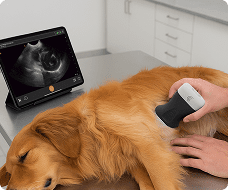
all right welcome back everyone I'm Serge and I'm CERN and now we're going to go through each site individually we're going to start with the subside for it absolutely and what we're going to do just for the sake of making this demonstration possible again we'll usually scan our patients in the position most comfortable uh Daisy here so our is our volunteer we're going to lay Daisy in left later recumbency just to make this a little bit easier to understand so and we're going to start again with that sub-zipoid site and go through all the questions we ask and answer there how do we find that subzifoid location uh with confidence well that's actually the most important thing to do before putting the Probe on the animals finding the subs I put couple things you can do you can find the 13th ribs on either side and Trace them to the palpable V in the middle and that's going to be the subside wood very important to do that and put the probe in there or else you risk not seeing the liver at all correct and you don't want to be too far caudal because that'll put you over the stomach so we do want to make sure that we tuck that probe as far cranial at that substitute as possible that's right we usually use just alcohol for demonstration purposes today we will use a little bit of gel just so that we don't soak our patient full of alcohol today all right so here we go I'm in the sub xiphoid and you can see that Daisy seems to be more comfortable in this position but no problem all right there we go marker is cranial we started seeing the liver there I'm going to adjust my depth so that I can see the entire liver within my window that's going to be very important because you want to see the entire liver exactly you want to see the liver the diaphragm and then the region beyond the diaphragm into the thoracic cavity all right there it is so there you go probe is in the subside region and we can see the diaphragm and the liver there so first question we're going to ask is so I want to know is there free fluid at this site yes or no so we're longitudinal how do we look for that free fluid and rule that in or out with confidence we're going to fan that probe on either side of the liver until the liver disappears on both sides to be able to say with confidence that there's no free fluid excellent so that's one question with ask and answer the next question I'll ask you what about that gallbladder how does that look and in cats we can often see a bilobed gallbladder but how does that gallbladder look yeah so we saw that gallbladder earlier and there it is right there nice and thin wall that's going to be the most important thing we don't want to see a Halo sign so gallbladder wall edema and then the third question I'm going to ask is that heart visible do we have pericardial Fusion or not that can sometimes be hard to identify in a cat but we're going to see if we can find that heart beyond the liver and the diaphragm in the suboid location as well yeah so interesting enough in this cat we can actually see in Daisy we could see the heart touching the diaphragm there it is beating over there a little harder I'm just going to get a little more gel on there but in a lot of cats the heart does not touch the diaphragm so we could see the heart coming in right there there you see the heart beating we don't see the entire heart but we see enough of the heart to ask the question do we have obvious paracorder Fusion yes or no and we actually see the cotovina Cava there too CERN which is another thing we want to assess what are we looking for specifically when we see that vinicaba what are the criteria we're looking for what are the things that help us uh determine if that being a Cava is normal or abnormal and what's it trying to tell us when we look at that so we want to change if I believe I'm correcting cats a change of at least 20 percent with respiration so we could see the change in the cotovina Cava diameter there which is good that is a normal kadavinikiva yeah and in this case here we also see a really nice cardiac pulse back to the level of the mini cable here you can see that radiation with the heartbeat we don't always see that in our cats but when we do see it that is also a normal finding that's right what about uh our caudal lung surface how does that look beyond the diaphragm are we seeing anything there Mirror Image B lines abnormalities so we see a nice mirror image on the other side of that diaphragm which tells us that we don't have any call to lung pathology at the sub xiphoid here so there's no lung pathology and there's also no pleural effusion here exactly that mirror image when we see that tells us we have air in this plane beyond the diaphragm so that means we can rule out successfully pleural effusion at this site that's right and then the last thing we want to look at we want to look at the stomach and how do we do that in our long axis so we can unrock the probe so we're more perpendicular and there's the stomach right there we could see nice big gas shadows in there and we can watch it to see if it contracts how many times is normal contraction in the stomach and we have that well determined in our dogs we haven't actually done the research to say in our cats but if we straculate from our dogs we should probably be looking about three to five contractions per minute that's right but again that research is lacking in our feline patients all right so that was long axis and then we want to actually flip into short axis and we'll repeat those same questions so we're going to get the image in short axis we can see it here with the liver nicely visible any fluid duct no fluid there I'm going to Fan the probe there we go so that the liver disappears and what about the colony cavity you can actually see it nicely here yep you can see the change in diameter nice cardiac um pulsation there excellent gallbladder can you show me the gallbladder and short axis I can try to show you the gallbladder let me try to see if I can find it again there it is right there so nice and thin walled gallbladder excellent and can you see the heart beyond the diaphragm in short access I sure can there it is right there and sometimes it is easier to see it short than long so we do encourage both views what about our pleural effusion or B lines off that diaphragm nope we got a nice mirror image on the other side diaphragm a soft tissue air interface there excellent and the last thing we want to look at because we're answering all the questions in both short and long do we have gastric fluid distension and or motility again the research is lacking on our feline patients but we would watch to see if we have any motility and or fluid extension which we don't have in this case that's right and that concludes our subziploid site lots of questions here lots of great information thank you thank you