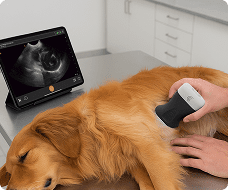
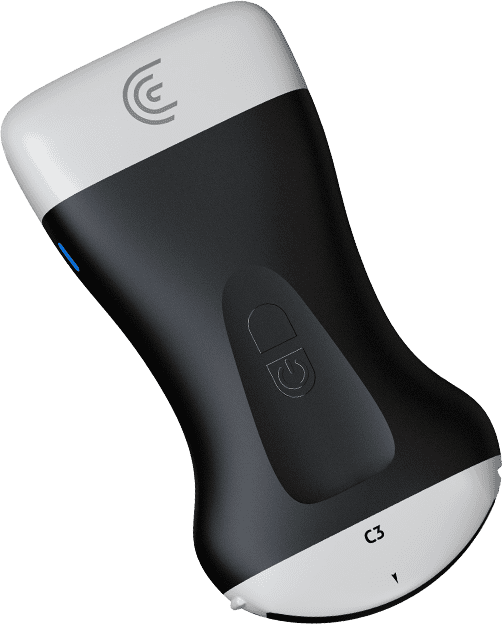
welcome back everyone I'm search and I'm CERN and what are we being looking at this time so now we're going to move our attention to the umbilical site this is probably one of the easier sites that we can assess so we're going to go ahead and look at that and again we'll do this in the patient position that they're most comfortable but for the sake of a demonstration we are going to place Daisy here in right lateral recumbency so we can look for and answer the questions we will find at that umbilical site all right now one of the big differences between our cats and our dogs when it comes to the umbilical site we can almost always find the spleen very easily in our canine patients but our cats that spleen does move a lot so we'll just see what we have when we look at that umbilical region how do we do that you can either look for the actual umbilical uh site that we'll often see you as a little scar in a lot of our patients or if you can't find that you'll sort of go halfway between the subzifoid site and the urinary bladder and we'll come in on Long axis to start with and we're going to look to see if we are in lateral for free fluid along that body dependent region down here towards where my fingertips are so when we're later we're going to angle towards that gravity Bennett region to look for free fluid we can also look for Loops of intestine here just make sure everything looks normal we'll do that in Long axis we will fan away from the tabletop just to make sure we don't have any pockets of fluid trapped within the momentum or the newhegans and then we're going to rotate the probe into third axis at this site as well again we'll fan cranial we'll check the intestines with fan caudal we'll Rock the probe down towards the gravity dependent region again with our patient lateral looking for fluid where my fingertips will be there's a difference of our patients standing I want to come in with gentle pressure not displacing that fluid and I want to come in dead center on midline with a probe directed towards the spine if we're looking for fluid in a standing patient so a little bit of a different technique in long and short axis between our standing and our lateral patients and in Daisy here we don't really see the spleen so uh we can't see that in all of our cats because the spleen is very Mobile in our feline patients but those are the questions we look for ask and answer at that umbilical site that's right all right well join us next time for our next slide merci beaucoup until next time