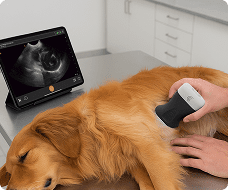
hello everyone welcome back I'm Serge and I'm CERN all right and now we're going to be looking at the urinary bladder site absolutely so we're going to show you how we find that and then the three big questions that we try to ask and answer at that site in addition to fluid all right so again we're going to go ahead and roll Daisy our volunteer she's uh just going to place her in right lateral so we can make this demonstration a little bit easier and uh we're going to go after that urinary bladder site now to find that site it's usually sitting in the collo region somewhere around the pelvis but it can be sometimes a bit challenging to find because we can have intrapelvic and extra pelvic urinary bladders so we do want to use the Motions of sliding and sweeping to broadly cover the region of the caudal abdomen until we can hopefully pick up that urinary bladder so I'm just going to place the Probe on and I'm going to start to sweep codily and there we go I can see the urinary bladder here in my window so I'm just actually once I've seen that Yuri bladder what are the questions we want to ask and answer there first question is there free fluid at the site yes or no which means CERN is going to fan from side to side until the bladder disappears looking for free fluid make sure you check the Apex of bladder and you come back and check both the trigone region and that Apex and again consider patient positioning our cat's in lateral so we do want to angle that probe down towards the body wall make sure we don't miss that fluid when they're lateral as opposed to straight in if they were standing once we've done long axis we want to rotate into short axis and again then depending on the size of the bladder we're going to fan and or fan and sweep to make sure we cover all planes to look for that free fluid that's right once we've looked for free fluid we're going to come back and find that urinary bladder at its widest point in short axis focus in on that and we're going to come in perpendicular and that's going to be a measurement that we'll do for urinary bladder volume estimation especially if we measure it serially over time that's right so we're going to get a width and a depth and short axis then we're going to rotate into long axis and we're going to actually again fan off both sides until or sweep and fan until we get to the widest point of the earning bladder or the pro perpendicular and again then we'll get a length and a depth here here and using that you can look at our webinars you can see how we will calculate the urinary bladder volume off the calculation of an ellipto order sphere that's right and then the last thing in our intact females uh not the case here with Daisy but in our intact females we can also look for pyometra and we'll do that by looking beyond the far wall of the urinary bladder but ventral to the colon so between the bladder wall and the colon in the dorsal regions we can look for fluid-filled structures which would indicate that we potentially have pyometra one thing you have to be careful about is that colon sometimes especially if you're not Fanning can mimic bladder stones which can be tricky as we can see right there yeah exactly so what you want to do is make sure you fan that probe to see the colon elongate and disappear so the colon is gas and fluid filled so it will elongate and disappear but if you kept it stationary it mimics a bladder stone absolutely and that is our urinary bladder site and we will conclude that move on to our next site so until we get to the kidneys thank you for joining us until next time foreign