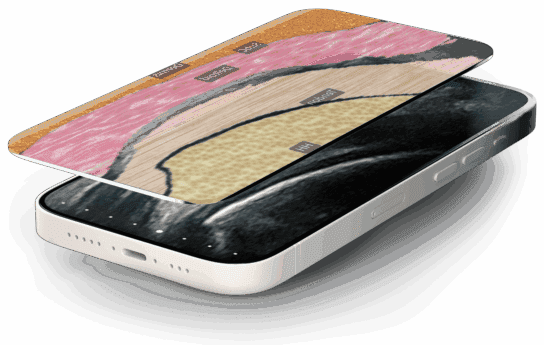
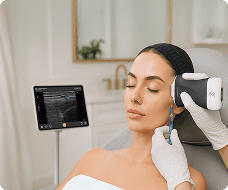
now we can move on and we can actually map the Super Truck layer and the supraorbital arteries now these arteries are very important for when we want to inject the forehead and if we want to inject the globular area now these are the most risky areas to actually get blindness and blindness happens in one to a hundred thousand injections so it's not very common but because it's such a difficult and severe side effect this is something that we really really need to prevent and the most risky areas for this are the glabellar area and the forehead and also the dorsum the back of the nose and the arteries that are involved in this are the super trachla artery the supraorbital artery and also the dorsal nasal artery so dorsal artery of the nose and so we need actually we will map them and we will start with a super trochler artery and the supraorbital artery and these arteries actually really change plane when they go up towards the forehead so they start at the area of the eyebrow and they are deep and at a certain area at around and under the lower fifths of the forehead they will change plane and they will go from Deep to superficial so that when we inject the forehead we can better be deep because mostly the arteries will be more superficial but still there is a variability and this change of plane differs from Patient to Patient so we'll just go now and map this arteries start with the B mode and we will see naturally the skin and the muscles and the muscles in this area are the proceros and the corrugator and these are muscles that we can actually can you frown [Music] okay so contract so you can see the muscle here Contracting and release so let's start with the super trochler R3 which should be here somewhere and we'll go to the color Doppler B mode so this is super chocolate artery here because it's more medial it's in the center but it's quite medial here so the level of this artery is at the corner of the brow at the inner Corner the middle part of the brow and we can measure the distance and it will be at 3.7 millimeters here so it's just where on the middle middle part of a brow and it's a 3.7 millimeters depth the supraorbital artery is more lateral and so I'm gonna check for it and it should go out from the supraorbital foramen and so there it is and it's just where the foramen is here it is this is the supraorbital and here again the distance is 2.9 centimeters so the arteries are here and they are at around 2.93 millimeters depth and so this is an area where I would not want to inject and mostly I will not inject filler there and if I've seen where the arteries are then I will naturally go to another area and inject either laterally or medially to the arteries so in her case we can inject the glabellar area more centrally so we can actually check and now that we've mapped the arteries and so we we could actually go on and inject more immediately in the glabellar area where there are actually no bigger vessels there another um something that we could do is because the forehead is such a risky area and if we would like to inject it we would want to map and see where the vessels are and there should be a change of planes so the vessels they should actually go from Deep to superficial as we go more up into the forehead so somewhere in the forehead the vessels the bigger vessels should be more more superficial the bone is the white line and above we can see the frontalis muscle and above that we can see the skin and what can be interesting here is that the vessels get more superficial and you can see here for instance if we measure it will be more superficial and it will go so you can see it's 1.7 millimeters so the vessels actually change and they go from Deep to superficial in the forehead