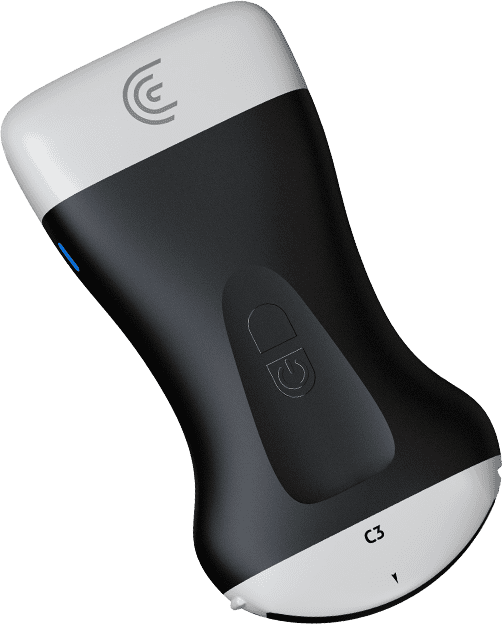
Hi, my name is Adrienne Sim. I'm a pelvic health physiootherapist and today I'm going to be showing you a functional applications of the transabdominal approach to looking at the pelvic floor. So again, important for there to be a relatively full bladder to make these observations. And we can have the client in any position here. and just um with these different positions just making sure that you are making uh good contact with the client and maintaining a stable probe. So today um we have our client in standing. So we're going to orient with the marker to the patient's left and then we're going to get our image on the screen and trying to get as crisp of an image of that bladder base as we can in standing here. And then we're going to get our client to do a pelvic floor contraction and then letting that go. So again, observing that contraction in this position. And then we can get the client to do an endurance hold. So we'll get the client to again do another pelvic floor contraction and hold 1 100 2 100 3 100 4 100 5 100 6 100 7 100 8 100 9 100 and let it go. So, we could see that this client could hold their pelvic floor for uh that 10-second hold. And then we're going to look at some coordinated contraction. So, their ability to quickly contract and relax in a fast repetitive way. So, we're going to get the client to lift and let it go. Lift, let it go. Lift, let it go. Four, let it go. Five, let it go. Six, let it go. Seven, let it go. Eight, let it go. Nine, let it go. and 10. Let it go. And that concludes the functional application for a transabdominal approach to looking at the pelvic floor.