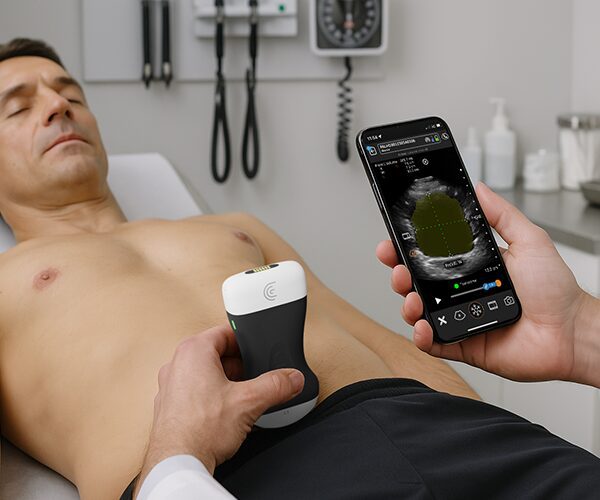
Hi, I'm Tom Cook. I'm an emergency physician that works with Prisma Health in the University of South Carolina. And this is a short video on using fractional shortening to quantitatively evaluate left ventricular function. This is a very simple uh way to see how well the left ventricle pumps. To begin, uh, we'll go ahead and start in B mode and we're going to acquire a parnernal long axis view and we would like to be able to see the left ventricle and try and angle the transducer in such a way that you don't get a lot of interference from the papillary muscles of the mital valve. And here we see a pretty good example of this. Once we have this, we're going to go into M mode. And M mode stands for motion mode. And what we do with this particular strategy for imaging the heart is we now see the B mode image has a tracer line through it and we take the changes in echogenicity along this line with respect to time and we display that on the right hand side of the screen. The yaxis is depth and the xaxis is time. And in doing so, when we look at this particular structure, we can see that this waveform right here is the movement of the interventricular septum. This structure down here is the movement of the posterior wall of the left ventricle and the paricardium. And then this black area in the middle is the left ventricle. And you can see the size of this in this particular dimension, the vertical dimension, changes as it goes through the cardiac cycle. It stands to reason that when these two structures get closer together that you are at the end of cyine and when they are farther apart you are at the end of diastily. And we can use this as a strategy and quantitatively evaluate how well the left ventricle functions. So let's get a nice good tracing and go ahead and freeze that image and we'll look for an area where we can measure the distance between the interventricular septum and the posterior wall at the end of cyine and the end of diastilly. Now, we're going to go into our measurement menu and choose vertical distance. And we'll go ahead and measure the heart at the end of cy and see that those two structures are right around 41 mm apart. And then we'll go ahead and get a second vertical measurement and measure it in diastley when the heart is full of blood. And we can see that that measurement is about 56. So the difference between the vertical measurement at the end of sis and diastily is right around 15 mm. We take that difference and we divide it by the larger of these two numbers which is around 56 and we should get uh about 33% is our fractional shortening. Now, it's important to remember that fractional shortening and ejection fraction are two entirely different things. We know that a normal ejection fraction is about 55 to 60%. For fractional shortening, our normal values are between 25 and 45%. In summary, fraal shortening is a quick way to quantitatively evaluate how well the left ventricle contracts in the axial plane and will help you with your patients when considering how well their heart functions in taking care of them for a number of different diseases.