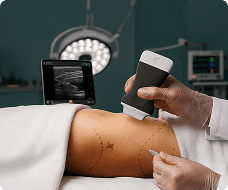
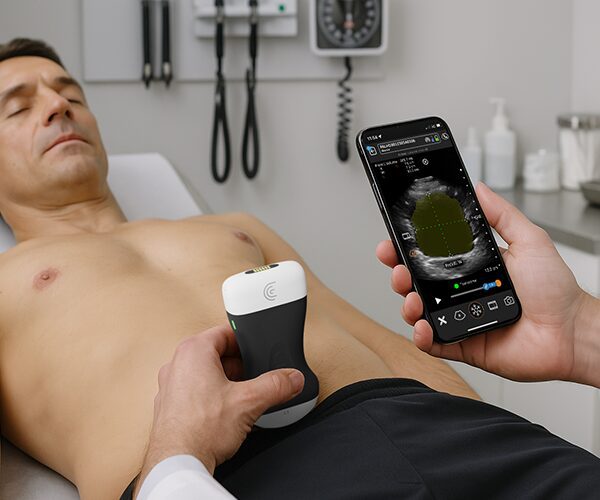
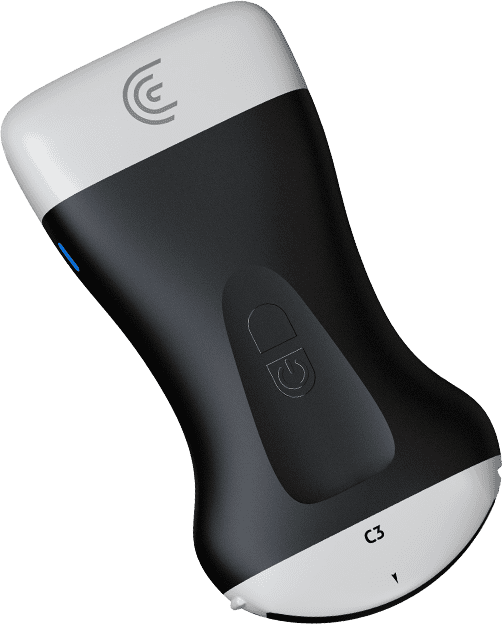
I'm going to have a patient laying on lying on their side facing away from me. The pillows that you all have can be helpful again just kind of putting between the patient's leg mainly because not just kind of bringing the tissue up to us but it does put a little bit of vary stress on it like almost like a vary stress test which means if I really want to keep that knee in an open pack position what's my ideal knee flexion >> about 30 degrees right okay so a little bit of open pack position for that and then if I'm looking for the LCL and we're going to look at lateral meniscus as well. Those are two main main structures I'm going to have you all just visualize today. Our bony reference point will be the fibular head. Okay. So, we're going to scan down and start trying to recognize that on this picture, the pictures that you have will be the far right corner. You'll see the fibula and that lateral collateral ligament is going to be the tight hypercoic tissue that comes off of it. I don't really expect you to get great visualization right now. The structures directly underneath. I do have them listed for you. You can see kind of part of the popius, part of that kind of femoral condile bersa and maybe that miscooral ligament, but those are kind of hidden underneath there. Some people they pop a little bit easier than others. But for our structure, our structures we want to visualize today will be the lateral collateral ligament, fibula, and we're going to trace that up toward the femur. All right. So again, uh patients in that kind of sideline position. And then from there, if we toggle or move our transducer slightly posterior, now we can kind of get behind that LCL a little bit and get a good visualization of the femoral tibial condiles as they come together. And I always kind of call it like a little pizza wedge. That's going to be that uh posterior lateral horn of the meniscus. All right. So again, we know that that's kind of intraarticular. So we are definitely not using an ultrasound to diagnose like a meniscus tear. We don't we can't see part of that. We're only using the edge of it. But if something has happened inside that knee and especially in articulate, we're going to see fluid. We're going to see extra fluid in around that area and that's somebody that you would have you would visualize with that positive brush test. And now maybe you're getting a little bit of clarification of I bet something's going on around that location. That's typically where for your all's uh ability a nice way to kind of visualize that. And then finally, we're going to lay our patient on their stomach so we can get a look at the biceps for insertional point on again that fibular head. So we're going to use the fibula as our reference point. We'll keep it on the bottom right. And then that biceps forous tendon will not be as bright as the um as the li as I'm sorry as the ligament, the LCL ligament. It'll be a little bit darker. Some tendons pop a little bit more. Think about the superpinatus tendon we see in the shoulder. That one was really, really bright. Some tendons have a little bit more of like a um homogeneous view, like a little bit of a blended view here. Okay, biceps morris will have a little bit of that as well. Okay, so think about that tenonopathy, insertional tenonopathy, that tendonitis that may be affected that biceps for tendon. Now, for the LCL, let let your palpation skills start first. Okay? as opposed to so many times we just drop a transducer and we're like where am I? If we're using the fibular head as our reference point then just palpate the fibular head and then let's put the transducer directly on top of that fibular head. So you can kind of see it pop like that. Okay. And so now you're going to see that lateral collateral ligament that nice bright tissue that's coming up on top. Okay. And as it inserts on top of the fibular head here. Okay. Remember bone's going to be dark cortical outline of the bone. And then you can slide up from there. Okay. So again, palpation skills will kind of reign supreme in this spot. There we go. There we go. My palpation skills kick in there. All right. So here's kind of again LCL ligaments right there. You can see it tapering off onto the fibular head. It's going all the way up. I can't obviously I'm not getting the full visualization but if I follow it up now I'm getting up on the femur femoral condile and I can trail and it goes away right here. Why? Well, that's because I'm getting part of that joint space and I've opened it up. Okay. But if you're suspecting a lateral collateral lateral tear thing about the rotational instabilities we talked about, you're not going to see those nice those nice striations. You're going to see a disruption and it's going to feel like either jagged or you're going to see actually like a dark cut in that location there. There we go. So now I'm starting to kind of go a little bit more posterior and not much. Again, that's still fibula there. And see this looks a little bit different than the picture I showed you, but there's the joint space. Okay. So visualize where the femur's coming down. I've got a fibula over here, a little bit of the tibia showing. There's my joint space. So if I tilt that transducer just slightly, I can have that meniscus maybe kind of become a little bit brighter. You can see it's already beveled. There's that little I kind of call it kind of like a pizza shaped showing up. It's five points pizza. Okay, those who know East Nashville. All right, so you can start to see that edge of it is going to taper down. So again, great location for me to scan if I'm suspecting any form of pathology there, like inside that knee. And again, I can make that coloring look darker just by tilting that transducer. See this edge of edge of the femur? See how it kind of like drops down? That's a normal edge of that condile. And that's a great uh bony landmark to know. Okay, now I've got a good view. I've got fibia coming up over here. I've got the edge of the tibia. If I scan a little bit more posterior, can I hang on to that? Do I see any type of fluid popping up in and around that area? Okay, so LCL lateral meniscus are really that lateral joint space. Okay. So now if you're going to try to get a good visualization of the biceps forous. Okay. Post the p the patient's going to be lying down on their stomach. I'm going to scan my palpation skills again. Palpate the posterior aspect of that fibula. And now just place a transducer on it. So again we're trying to use superior to be the left of the screen. Brightest of screens inferior. This kind of for our sake visual visualizing it. It makes sense. Okay. Sometimes it just doesn't quite make sense. Um, again I can make that that fibular head pop. There's that biceps for tendon really really bright here. Then it starts to become a little bit darker as it starts to go a little bit more superior. But if again this would be a loca great location if I'm suspecting some tendonopathy to pause it do that little bit of a measurement to see any type of thickening or do I suspect u an active tendonitis like is a fresh one. You won't typically see any thickening because that's typically indicative of one that's been there for a long time. But it will become brighter. Um, which would be a dead giveaway that I'm dealing with an active inflammation.