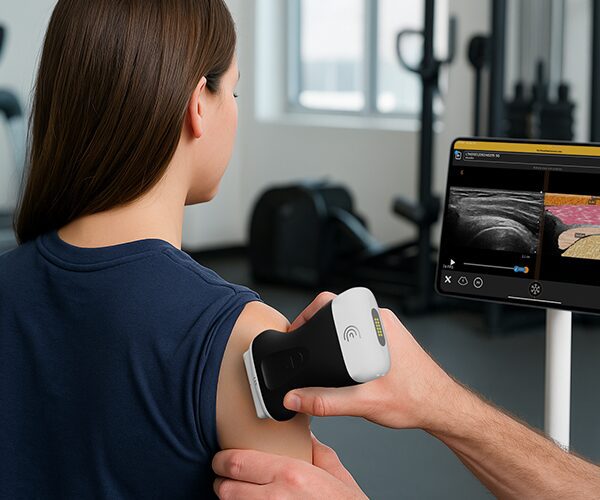
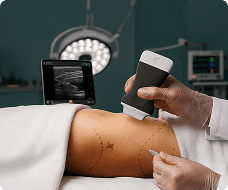
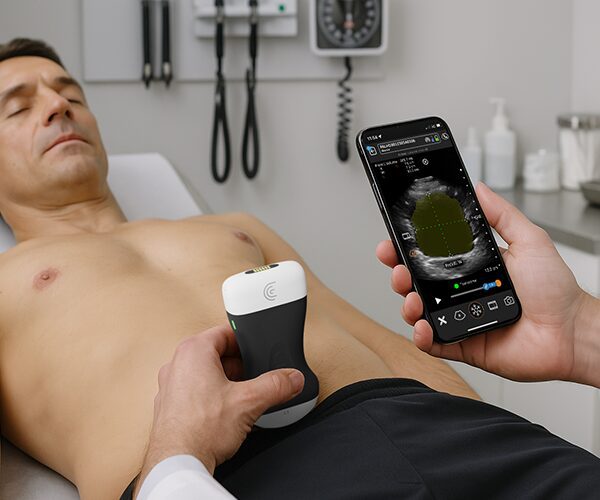
Now, we're gonna be looking at the same structures, the medial collateral ligament, and now the u a lot of times when you're set up that way, you can see a visualization of the meniscus too, medial meniscus. Okay. So, in this case, I'm going to flex that needle about 30°. Place that transducer. Try to find that that joint space. MCL is going to be that really bright band underneath it. And then you'll see the femoral condile and the tibia. Look for that pizza wedge shape for the meniscus as well. Okay. After that, I will roll the person over slightly and I'm going to trace down the PEZ tendons. Okay. So, my I'm going to go all the way down to where they insert onto the tibia. Now, if somebody's dealing with like a active berscitis, it will show more. Okay. So, remember bersa is going to be dark. It's going to be anooic. Usually for bersa sacs, they're really hard to visualize if somebody's not dealing with any type of active fluid. So most bersc should be about 2 millimeters or less. And that's hard to visualize when it's compressing between tendons. But if somebody's dealing with an active burcitis, it'll be larger than 2 millimeters and it'll be dark, the anacoic. And a good way to know is that what I'm looking at, especially in this case, if you add a little pressure, sometimes the transducer alone, you have to be careful that the weight of it will push and flatten that out. But if you're suspecting fluid, sometimes you can compress it, make it go away, take the pressure off, and you'll see it actually come back because it's contained u in like a little bubble. Okay. So, those are our structures that we're going to look at from the medial portion. All right. A little bit more gel here. There we go. Okay. So again, I started here. I recognize bone. I'm trying to figure out, okay, where's my orientation? I slide down. I'm using the joint space now as my reference point. I know I've got femur to the left. I've got tibia to my right. And that bright tissue that's laying across, there's that MCL. Okay, so that ligament is going to be super bright. You can see the shadowing or the shading of the meniscus right underneath it. Okay. So again, remember a brush test for intraarticular fluid. We primarily look at that medial side of the knee. This is the one location I do a lot. I can trace this down all the way. You can see that bright tissue on top of that tibia. That is all MCL and that's a broad flat band. So me to really assess that I'm going to go posterior and scan a lot of those fibers. I'm going to scan up a little bit more superior so I can see any break or there's any tearing or loss of those tight striations. Okay. Again, this is somebody I've already done a clinical exam on. I've done some VGA stress, maybe some moving VGA stress tests. If I want to do that dynamic assessment, I'll go over the joint space and then I'll have them extend their knee slowly and I'm looking for that little pocket of fluid to push out and to bubble out. And that would be That would be helpful for me to know understand that something's going on on inside that capsule. Okay. Interstitial swelling that's outside of that capsule. It's not going to move around at all. Okay. So, MCL joint space. Try to get visualization of that medial meniscus. And then trace it down right to the edge of that tibial tuberosity right on your tibia. Now, I'm looking at those tendons. So, I see the tibia there. those tendons, that's going to be the bright tissue that's on top. Okay? Again, that little dark area right there. That burst of sex lies lies right underneath it. And it's not going to be visualized right now because it just don't have any fluid. Okay? But it's going to be right underneath those tendons, right on the edge of the bone. If it's swollen, you'll see it puff up. You'll see like a little bit of a black bubble. And I believe I have that in uh one of your pathology slides as well.