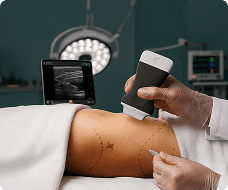
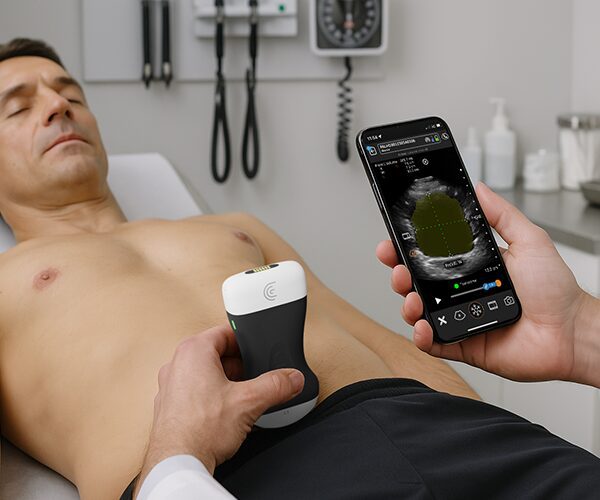
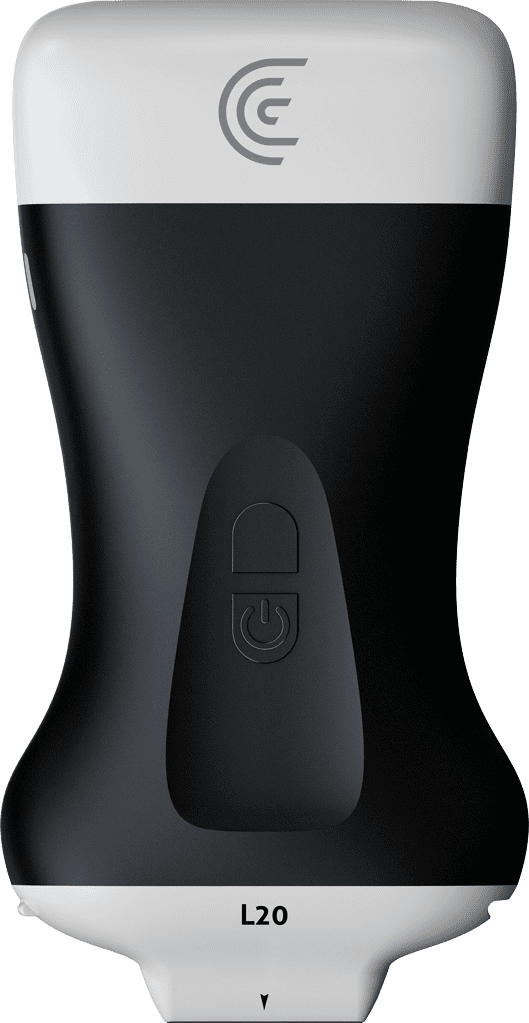
hi there my name is Dr MJ Roland varman I'm a dentist based here in Liverpool UK my practice is limited to aesthetic medicine in my day-to-day life I see a lot of aesthetic complications for which I run a dedicated complications Clinic today I'm going to share with you a case where ultrasound really came into its own I'm going to use my l20 to solve a case where permanent filler had been placed some years previous and which was now causing significant problems in cases like this an injector's diagnostic ultrasound and patient management skills are really tested to their absolute limits I cannot wait to share this case with you so let's get started let's get to our case this is our patient she's a 57 year old lady who is suffering with significant aesthetic disfigurement due to pre-existing filler treatment as you can see the midface appears very overfilled and lumpy she reports that she had a product called bio alchemid around 15 years prior to treat facial volume loss she describes there was some mishap with it on one side she's never been completely happy with its appearance over time she has noticed that the surface has become lumpy especially around the nasolabial fold where it feels harder she is not in pain has never suffered any redness or irritation her aims are simple she wants an aesthetic Improvement the temple and lateral face are bothering her as these are very Hollow in comparison to the midface which is bulging there are indentations on the surface of the skin on palpating I feel fluid movement beneath my fingers when I press on the mid face the lateral cheek pops out and vice versa it feels like a significant deposit Under the Skin So let's check this with ultrasound there's a very large homogeneous mass-like hypoechoic structure with a thin poorly defined hyperechoic border there are irregular High protocolic internal Reflections which vary with application of pressure to the area this means it's liquid inside you can see the fluid moving back and forth it exhibits posterior acoustic enhancement comparing it to the other fillers we've just seen this is definitely polyalkalamide and is the typical presentation of this product in its liquid or semi-liquid form in for orbitaly there are significant polyalkilomet deposits here you can see the infraorbital foramen in close proximity to the filler you can see a thin sliver of orbicularis oculi overlying the filler compared with normal anatomy where all the tissue layers are clearly recognizable in our patient the anatomy has been severely disrupted by polyalkilomate the high polarcoic deposits extend laterally along the orbital Rim in the mid face there is a similar picture of large mass-like deposits of hypoechoic polyalkalamide with its characteristic internal Reflections laterally in the midface is a more calcified structure within the polyalkillamide which is firm on palpation more laterally still is a homogeneous hyperechoic structure which is the parotid gland again there's significant polyalkilomate deposits associated with the parotid and deep to the parotid fascia in the region of the zygoma deposits of hypocoke polyalkylamide can be seen in the superficial and deep compartments separated by the smash layer completing our overview scan of the mid face and coming back to the infraorbital area it's evident that we have a significant filler load to our patient's mid face in both the subcutaneous and deep fat compartments and extending between the tissue layers this presentation is replicated on the contralateral side and also extends into the lower face and into the Jawa here we can see there is filler encroaching on the parotid gland and that it is even displaced into the parotid that one obvious option ultrasound guided injection of polyalactic acid it it takes all of the boxes and there are many long-term studies citing satisfaction rates of over 95 plus over multiple years whilst it doesn't grow fat back it improves dermal thickness complications are rare most notably nodule formation which happens in around five percent of cases they don't usually cause aesthetic problems they resolve on their own so I felt this was the best option for her it's not a complete resolution but a compromise the Opera Temple is clear of polyalkalamide this anechoic structure is the superficial temporal artery which is expected in layer 3. this anechoic structure is the Sentinel vein it runs through the layers of the temple from the interfacial plane and can be huge up to nine millimeters diameter so its snaking pattern is pretty easy to spot this informs me that my Axis for temple augmentation has to be from the temporal Crest to avoid the massive filler lower down now checking the cheek Hollow with layers of skin subcutaneous fat parotid masseter and Bone I'm content this section of the face is free of polyalkalamide and I will choose an access from the Superior part of the lateral cheek to place plla into the subcutaneous plane starting the treatment I've guided my cannula into the subcutaneous plane I can see I am above the superficial temporal artery and once I am happy with my position I can inject it may seem like I'm very close to the sca but you can see a tissue space between my cannula and the vessel and the SDA is encased in fascia I'm also using a 22 gauge cannula which is my preference and reduces the risk of vessel trauma further I deposit a little more product and work my way across the temple here you can already see some Sculptra which is now acting as a spacer between SCA and cannula this is the motion or Flash artifact caused by the fluid coming out of my cannula any rapid movement will cause a Doppler shift going back in I can see there's a good amount of product in this tissue layer now don't forget the liquid in Sculptra disappears over a few days and leaves behind the plla which will start to induce collagenesis in the coming weeks now moving on to the cheek Hollow again I have placed the cannula into the subcutaneous plane it's incredibly thin less than four millimeters according to the scale on the right you can see how product can easily end up in the parotid if not using ultrasound checking my depth carefully placing the product there's another motion artifact I repeat that until the area is filled so let's see how we got on here's her before and here is her result immediately post-operatively you can see that the temporal hollowing shows a marked improvement her cheek Hollows also appear a lot less concave and the overall result is one of softening the very prominent lumps especially on the cheeks seem a lot less obvious she was delighted there's so much you can do with Ultrasound with ultrasound in your skill set there is truly never a dull day and it will be one of the most useful tools you will invest in for your practice