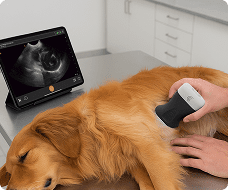
and welcome back everyone i am serge and i am cern and now dr boyzen we're going to be talking about how to rule in or out pneumothorax all right so again this is going to vary depending on patient positioning our volunteer penny here is in lateral recumbency we can look for pneumothorax and lateral recumbency what we got to think about is the pathology we're looking for and where that pathology will accumulate based on patient positioning so in lateral where is that going to be that's going to be the highest point of the chest dr poison because air rises so we've got to actually find that cap of air with penny and lateral recumbency but let's pretend because most of our patients that are going to come in with the pneumothorax are going to be more comfortable and we want to scan our patients in the position the most comfortable in a sternal or standing position and if they're in stern or standing position dr loop where is that air going to accumulate well we can use our boundaries dr poison and it's going to be caudal dorsal so if we can find the caudal dorsal boundary that's going to be the highest point of the chest that's where we can rule in or out pneumothorax for that hemothorax all right so i'm going to give you the probe and we're going to see if we can find that border using our ultrasound to classify and identify the key sites that get us to that caudal dorsal site so we're going to pretend penny for the sake of the demonstration isn't stern or standing let's find that most caudal dorsal sight all right so what i like to do is to go ahead and start behind that cranial border so that we're sure over lung so dr poison i'm going to get you to put some alcohol there we're going to part the fur and we like to pull the skin a little bit cranial and ventral so that again we can use less applications of alcohol when we do our scan so we put a probe there we're at the cranial border plus border which is limited by that forelimb and i'm looking for the bad sign and there's that plural line dr poison and i can immediately see that shimmer so we have lung sliding at this point here what i'm going to do is again this patient is sternal or standing i'm going to go find my cauda border by just sliding my skin all the way back you've seen that avoids all the alcohol that we would put on this patient otherwise and we could see there we go dr bozen we can see that curtain sign which is the caudal plus border absolutely we see it just coming in behind that last rib there there we go we can see that vertical edge artifact over the stomach because we're scanning the left side of our patient now penny and that's our caudal border so this is now a good location for us to say we don't have pneumothorax here either i can assess that curtain sign as normal but again not true being if there's no pneumothorax at this site are we at the most sensitive site if our patient's in a stern or standing position again air rises so we have to go to the most caudal dorsal position and if we just follow that caudal border up all the way up all the way up and look at that we can still see the plural line all the way all the way up just disappeared gone and now we're in muscle so now i'm going to come back down dr boison until i find that plural line again and look at that we can see a shimmer there or lung sliding we're at the highest point of the chest dr poison the fact that we see that shimmer the two polar in contact we do not have pneumothorax on this hemithorax correct and now we've looked at and ruled it out at the most sensitive site so therefore we feel confident then that we have actually ruled out our pneumothorax on this side of the chest and again we can often look for abnormalities on that curtain sign as we slide up along that caudal border but that is how we look for pneumothorax and if you want to do that again just real quickly in real time so we can i'll put some more alcohol on there all right so here i am again i am sure i am over lung because i'm at the cranial border i'm going to go ahead and slide that skin backwards i've already asked myself do i have a glide sign immediately when i saw that because there might be a massive pneumothorax and you might not have a glide sign where you put your probe on there but we did there dr boison and there we go we're at the caudal border right there went from craniocauda border and now i'm going to go all the way upwards until i lose that glide right there it's gone i'm going to come back down and there it is there's that plural line and i see a glide sign dr poison which means they do not have a pneumothorax on the semithorax perfect and that is how we quickly rule out uh pneumothorax an external or standing patient or as we said if it's in a lateral position as penny is here then we're just going to pick that widest spot and look for the lung sliding at that lightest spot and we'll also also look at that curtain sign with them and lateral and explore that for abnormalities suggestive of pneumothorax excellent