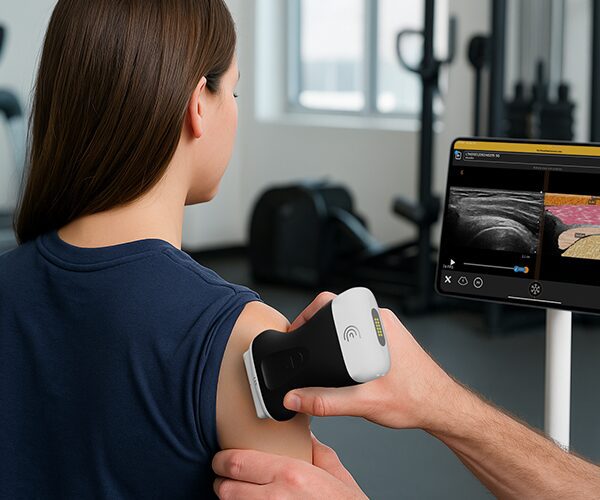
okay to scan the distal bicep standon we can have four approaches and every approach has its own advantage and also disadvantage and the first approach we're going to take is the vental elbow the patient is Seated on the other side of the table and we're going to put a little bolster underneath the elbow so that the elbow really opens up and to help to visualize the dle bicep standing a little bit better we're going to make a supination so that the uh radial tuberosity moves up that's the insertion of point of the biceps and this highlights the biceps a little bit better so the first approach going to take is a transverse View and for this uh transverse view uh what we will do is uh we're going to search for this uh typical appearance uh of the um uh the the capalm and also the tra of uh the the humorous and on top of this yeah this wavy appearance we can see the brachial muscles with uh right next to it we can see the median nerve the brachial artery and the spelic vein in between the spelic vein and the brachial artery we can see a hyperic entity and this is the distal bicep standon if you're not sure whether this is truly the uh DL biceps standon then we can follow this biceps up to proximal and you will see that muscle fibers will start to arise from this tendon so these are muscle fibers of the uh braal muscle uh and if I go back to distal you will see that the hyperic part the internal tendon becomes bigger and bigger turning into a tendon and the um muscle fibers they disappear and now you can see that this is truly the biceps tendon we're going to follow this distal biceps tendon to dist and we will probably not be able to follow it all the way to its insertional point to the radial tuberosity but we going to try so let's make sure that the patient is really in a supination if you can hold it like that and let's uh follow to distal and we are going to tilt the transducer a little bit um uh like this in order to keep the tendon hyper aoic as possible as it has a very uh oblique course right up to the um the insertional point we're going to look at the cross-sectional area of the biceps and whether there are fluid accumulations within the tendon or around the tendon and uh let's slide as deep as uh as possible so going back to proximal because I cannot really see the full uh insertion of this disle bicep standon we're going to again check the cross-sectional area right there but also Al the fibers of the lerus fibrosis which run from the diso bicep standon as you know towards the flexor muscles uh where they also um have a insertional point so this is the uh lerus fibrosis and this we are also going to scan to see whether these fibers are intact uh and that they are as they should be thin and Hyper aoic this is important to check uh because if this is stor uh surgery is needed and the biceps will probably retract too much to proximal in the centeral view we can also look from a longitudinal point of view and again um let's highlight the osteology first uh here we can see the capitellum of the humorus with the capsule here we can see the um radial head the radial uh neck and the radial shaft and here we can see the radial tuberosity uh with uh the bicep standon attaching uh to the radial tuberosity right next to the tendon is of course the uh brachial artery so this could serve as a landmark if you are too far to medial you can see the uh brachial artery pulsating right here so we need to be a little bit more to the lateral side of this uh this artery again it's quite hard to visualize this um this uh the standon insertion due to the obliquity uh so we are going to check this um uh with other approaches uh medial dorsal and also uh lateral I'm I am going to check uh once again the distal of the distl biceps muscle fibers in this longitudinal view right here