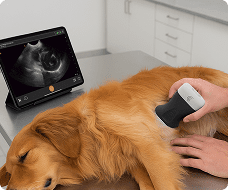
welcome back everyone i'm serge i'm cern and now we're going to be talking about the two paralumbar sites let's start with the right paralympus site dr boyson okay and we're going to actually start with the right paralumber site we're going to show you and again penny's in a lateral position that's the position we're going to do the demonstration and keeping in mind we scan the patient in the position the most comfortable so to find that paralumbar site this is actually one that a lot of people struggle with sometimes penny is in left lateral recumbency so this is the right kidney that we're going to go and access now often what i'll try to do this i'll follow those ribs up so i'm palpating that caudal rib site here and i'll palpate that up until my finger is pushed out by the sub lumbar muscle structure and that's often a really nice place to start with we separate the fur so we can see the skin we apply alcohol at that location we're going to put the probe right on that location where we can see the skin and we'll start long axis now often on the right side that kidney is going to hide behind that last rib so i'm scanning behind the last rib and i can't quite see it so it's going to be located probably a rib space cranial and i'll actually jump ahead one rib here dr schlub and when i do that look at that lovely kidding that we see now sitting between the 12th and 13th intercostal spaces so again remember when you're scanning for the kidney you may have to actually especially on the right side come between the ribs as opposed to scanning and trying to find it caudal to that last rib once we see that kidney dark loop we're going to actually fan all the way off one side we'll fan all the way off the other side with the kidney in the long axis so that is definitely something we want to do there dr and what are we looking for when we're doing this dr well like at every other site dr boyson we want to look for free abdominal fluid at this site so that's part of the fanning doctor boys and there's something else we can look for here which is free abdominal air absolutely so our patient is again think about patient positioning the pathology we're looking for if it's air that working for air rises as opposed to fluid that falls so we're going to look to the most gravity independent regions when we look for that free air so we're going to identify that peritoneal lining and we're just going to fan and move along that particular lining and look for the enhanced peritoneal stripe sign and reverberation artifact you'll have to watch one of the lectures that talk about that to be able to see that in our patients that have uh free air in the abdomen but that's what we're going to do and look at this site as well free air in the abdomen by identifying that peritoneal lining which you can easily see here the kidney is tucked up against that perineal lining once we've done long axis dralub we want to go into short axis dr boison so you rotate that probe 90 degrees and we know that the kidneys are difficult to scan especially between the ribs and especially this right kidney because again it's tucked in between the two ribs so it's a little hard to see that one and there you go you have a nice short axis image there dr boison so we're going to ask those same two questions do we have free abdominal fluid do we have free abdominal air at this site all right so we're going to actually fan all the way off in short axis and then we'll fan off the caudal pole we'll span off the cranial pole dr schlub make sure we don't see that free fluid as you alluded to all the way off exactly and always fan off the kidney on the right side will usually hit the liver so that's the liver that we're starting to see here come in and there you see that the kidneys just tucked into that hepatorenal fossa there all right dr boison well another question binary question we can ask here this is for cats two studies show that general practitioners people doing point of care ultrasound can ask is there significant renal pelvic dilation and this is really cool for that cat coming in with severe isotemia and you don't know if it's renal or post renal you can get this image oh beautiful image you have there dr bois in this pac-man image here that we have here with the reno papilla and that pac-man shape there of the crescent there dr boyzen and we could see that if there is a distance between the papilla and that pac-man of greater than 13 millimeters then we have a ureteral obstruction in cats coming in with gi signs and html a great uh thing to look for and there's lots of evidence for that now out of the royal veterinary college so that's something we look for in short access lots of different ways we can look for that renal pelvic relation we like to do it in short axis and you can see that here it's a little harder on the right kidney in the left but we do have a nice view of that renal papilla here and you can look for that renal pelvic dilation so that's something you can do in short access is the easiest way we find to do it uh lots of evidence out there now exactly yeah exactly so binary question is the renal pelvis in short axis in cats greater than 13 millimeters yes or no which is indicative of a ureteral obstruction so what else can we look for then at this right paralumbar site dr well dr boyson just like we looked at the stomach for ilias we can go find the duodenum or duodenum and ask ourselves that same question is there gi contraction at the duodenum yes or no and what we want to do then we want to actually span off of or sweep off of that kidney and long axis we're going to come down until we find the thickest wall of the small intestine and that's usually the duodenum we can start to see that coming in right here we do have some other loops of intestine in here we have some colon in here which is a thinner walled intestine but we can see the loops of the duodenum here and we're just going to actually put our probe here and again we're going to watch to see if we have any gi contractions or motility here that helps us determine if we have alias present or not correct dr boyzen so we're looking again for you breakdancing in there and if we see that we know we do not have generalized ileus all right so again the easiest way to do that find that kidney and long axis and just then sweep to the medial side and look for the largest wall of the intestine and we see some nice in luminal contractions there in pennies that tells us that we do not have generalized ileus and we can see that nicely here in the short axis i turned that into the long axis there and oh there we go actually look at that nice intra-luminal contraction that we have in penny ruling out generalized ileus at that right paralympic site by picking up the duodenum good job penny look at that oh look at that control oh look at those contractions you