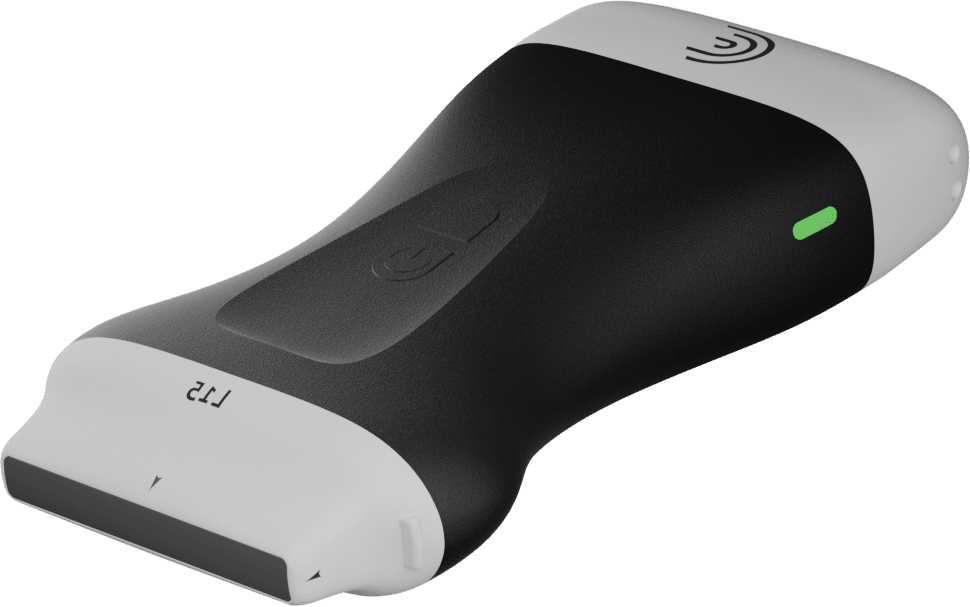
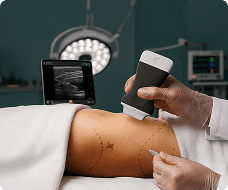
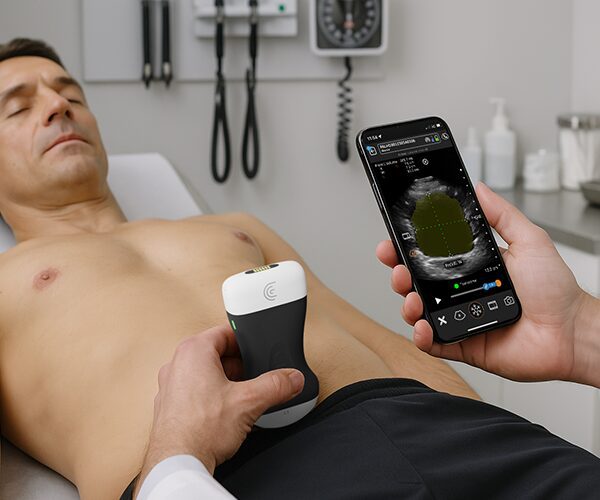
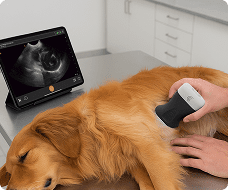
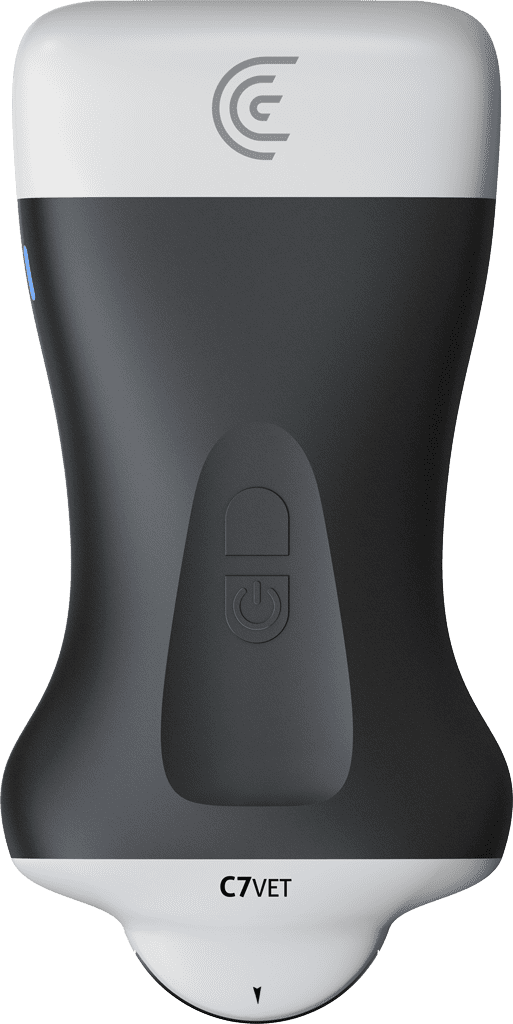
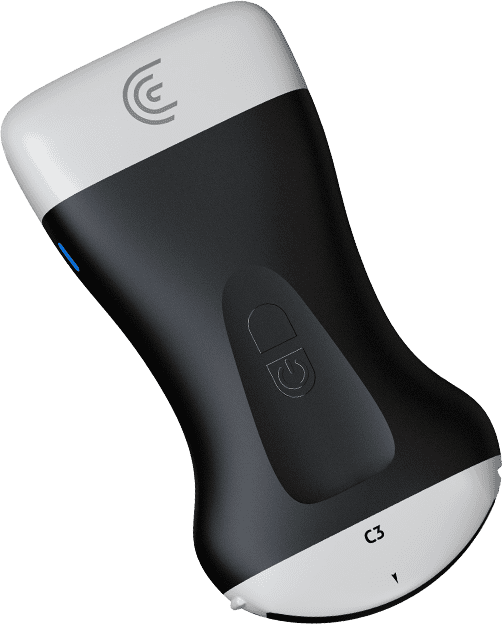
Hi, I'm Angie from Aspire UCS and today we're going to cover step one of our eightstep abdominal ultrasound survey. Now in this step we are going to cover the diaphragm, the liver, the gallbladder, the common duct and the portal vein. Now obviously if we saw any lympadinopathy or any pathology while scanning those structures we would be making sure that we image them and measure them so that we can report on those also. Okay, Lily. So, come on. Let's see if you behave. Let's roll her over >> very gently. Does it good girl? So, we're gonna make sure that the orientation marker is towards the patient's head. And this light on the clarius corresponds to the left hand side of the screen. It's really important you get your orientation marker correct. So, if we're doing long axis section, which we're going to start with, of the liver, we want the orientation marker to be facing Lily's head. And that corresponds to that Clarius logo. So pop a little bit of jelly on here. Pop the probe on. Subzifoid in a long axis section in the midline of the patient. Absolutely great view this. It's one of our favorites because we get a by cavity view. So we can see the mirror artifact here. This side of the diaphragm which helps to prove that there's normal lung tissue there. You wouldn't have that in view that uh tissue mimicking liver the other side of the diaphragm if you had abnormal lungs or a plural eusion. We can also see the heart. So if there was a big obvious pericardial eusion or a problem with the heart, we should see that too. But we're going to concentrate on the liver now in long axis section. So we want to make sure that our diaphragm, which is this bright curved uh surface here, comes to the back of the screen there like that. Okay? So that we don't chop any liver off. Then we're going to angle upwards behind the breast bone so that we get the very cranial aspects of the liver. Now, Lily is a small dog, so we're going to get the length of her liver, probably in one sweep, going down towards the table and back up towards the ceiling. But you may need to do this in strips, almost like in a hashtag kind of appearance, so that we don't miss any parts of that liver out. So, first of all, we're going to scan down towards the table, slowly paying attention to the structures as we go down. You can see my hand tilting down towards the tabletop. Now, get a cheeky peek here at that gallbladder. And there's our mirror artifact again of the gallbladder, the other side of the diaphragm. Carry on scanning until we run out of liver. >> I think that's really important that you keep scanning all the way through to the outer boundaries. Otherwise, you will miss something. >> Yeah. And that's important for any organ that you look at. So, we're in long axis here. We've gone all the way through. And you can see we're running out of liver there. And then we're coming back now as I tilt my hand back to the horizontal. This is the midline. So now we're going to start looking at the left lobe of liver as we tilt up towards Lily's left shoulder. And this is all left lobe of liver. Here we've got her grossly extended stomach in view. I know. And then we carry on scanning until we almost pop off the rib and we run out of liver. You can see it's gone there now. And then I'm going to go back down for good measure. Just having a good look. We want to be looking at the parankma, the outline, making sure there's no intrahypatic duct dilotation, no abnormal vascularity that we can see, big anomalous veins that might suggest a shunt. We're looking at the size of the liver, too. So, are the boundaries and those cordal margins of the liver, are they pointy? Do they extend beyond the level of the stomach or are they rounded which might suggest that there's some um enlargement of that liver? So we've been all the way through that liver now nicely in long axis. I'm going to rotate my probe so that the orientation marker now goes down towards the tabletop and again still pointing upwards behind the breast bone. This corresponds now the left hand side of the screen to Lily's right side. And here we have the gallbladder. And the diaphragm, as you can see, is now much more horizontal on the screen when compared to the long axis view. If I go back to this, where it's coming across this left hand side of the screen. So you can tell what view you're on just by the position of the uh the diaphragm. Now I'm going to scan all the way up behind the breast bone. So I'm tilting this direction so that we run out of liver. And it's important to sweep through slowly so that you don't miss any subtle or small changes. If you just whiz through really quickly, you could miss something. >> And too many people just think that a couple of flips through the liver and then you've scanned it. But you really do need to have a good look at that. So there's the right side. This is the left um lateral aspect of the liver. And you can see these hippatic veins here that actually drain down towards the vennea here at the um hippatic confluence. So a really important look there at the liver. Good girl. And that's lovely. So we got a nice smooth even parankma a sharp border almost linear here the capsular margins and no intrahipatic duct dilotation and no obvious uh mass lesion focal nodule etc. Let's bring that into the center of our screen here because ideally that's what you want to do with anything that you're going to look at on ultrasound. The region of interest should be in the middle of your screen. And I'm now going to keeping my probe in that short axis approach because I've located my gallbladder. I'm actually going to scan all the way through one direction and then all the way through in the other direction. Keep going. looking around the gallbladder, making sure that there's no pericolcystic fluid, that the wall is nice and thin and regular, and that there's no obvious filling contents or defects that might worry us. Um, it is quite common to find a little bit of layered sludge in dogs normally, so don't overall that. So, now I've had a look all the way through and I've gone back down towards the gallbladder neck here. Now, if we were to have sludge now, because OT is lying on her right side, then this is going to be the gravity dependent part. So, we should get a little layer of sludge that's occurring in this direction, but she's got no sludge in there. Now, I'm going to turn through 19. Look, we've got a beautiful mirror artifact of the gallbladder here on the other side of the diaphragm. Um, that's one of the artifacts and that does help to show that we've got nice normal lung as I mentioned earlier. So there's our gallbladder in long axis. So if I just pause here and I'm going to take a representative image of that. So don't forget your cheeky little cinny loop. That's a really useful tool because what it can do is it can take you backwards and forwards to previous frames so that you find the one that you need the most or that you liked earlier. And this one here we've got just a little bit of the neck coming on. So just there bit more of the neck. So it's quite nice for the long axis. And what we would do now is we would actually measure the gallbladder wall. I always do this because it's just um standardized approach because that way I'm I'm never going to forget to do it if I do it every time. And it's a very very thin wall. So it's just going through the motions here. But obviously you're going to tap it and then adjust it. And I'm expecting this to be really super thin. It's going to be about a millimeter. Hardly hardly measurable at all. So very happy with that. take a representative image and there we've had a look at the gallbladder. So in this same region here now what we have here is we have the neck that actually goes into the cystic duct. There's our portal vein coming in below here. Just try and get a nicer view of it. There's our portal vein. There we go. And what we have following along there will be our common duct which is just here just there. Just freeze there. Cine loop back again. She's having a little wrigle. So, it's important to assess this. Measure the in intral luminal diameter to make sure that there's no dilotation. Um, and if you have got a very wide tube there that's running parallel to your portal vein, then that would raise suspicion that there may be some obstruction further down distally. So, it's important to check that douadal pillar area and look at that common duct in its entirety. So if we were to measure this again, we would just want to measure inside the lumen. So there to there and just inside. Beautiful. And again take a representative image. So what we would want to do then is if we can't see that from this plane or in this particular view, we could look at this check this out when we look at the underside later in step eight. So now let's have a look at the portal vein. So it's important to not confuse the portal vein with the cordal vennea. Um and there we have our portal vein here coming in. So the cordal vennea is lower down then it's the aorta. So there's different levels as you scan from down the table up towards the ceiling. And that's how I check it out. Um there we go. So there's our nice little common duct with our portal vein. And let's just see if we can put a bit of color on it just to show whether that is the portal vein. And there we go. There's our portal vein here. This one here. So, this is the vennea and there's our portal vein. So, we mustn't confuse the two.