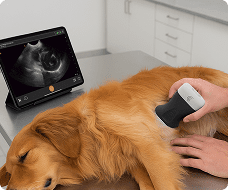
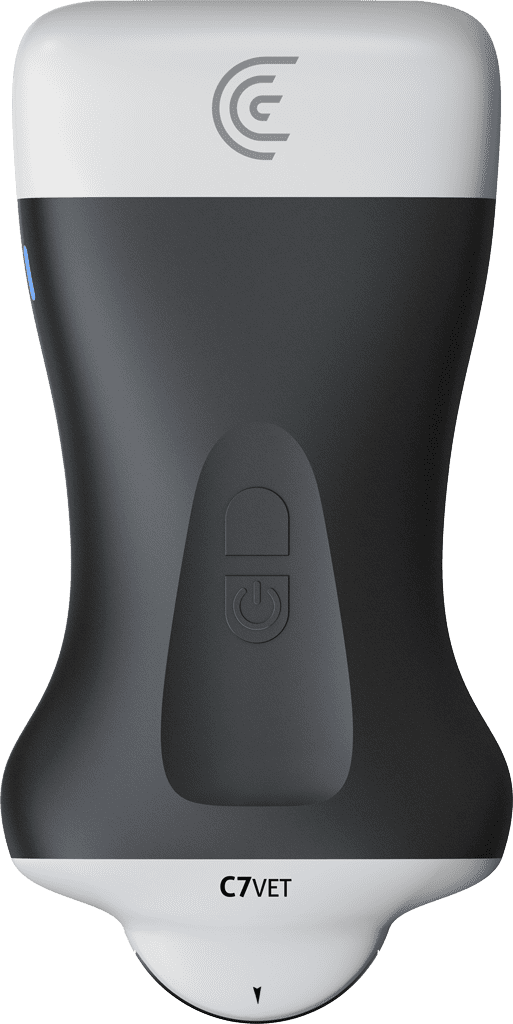
Today we're going to go through step three of the Aspire UCS8step abdominal survey. Now step three is probably one of the easiest steps to start mastering if you're new to ultrasound mainly because most the structure of the spleen is quite superficial. So it's also approached from the left side, the upper surface of the dog. So it's a good one to get practicing your motor skills because we tend to use quite large broad strokes for that. It's also important when we're scanning the spleen to make sure that we cover the head of spleen. Now, spleens vary in their position in dogs in particular, but you'll always find the head of the spleen tucked right up under this costal margin. So, don't just scan up to the border of the costal margin like I did for the first few months that I was scanning and I didn't realize that there was the head of the spleen under here. You need to angle right up under which we'll show you. So start with the orientation marker once again towards the patient's head for long axis to pick up that splenic tissue in the first place. That's going to correspond to the left side of the screen which is the first crystals that are fired when each given frame is built. So we'll start. We've got some jelly on lily already. We're just going to scan down towards the table. Now superficial structure. This is the spleen here. So quite difficult to see if you've got your depth all wrong. So what we want to do is we want to be able to visualize that spleen. Now the first thing that I would do is I actually map out whereabouts in the dog does the spleen go. So I'm going to follow it. Now with Lily, I know that her spleen comes all the way across here. Carry on. This is still spleen. This is still spleen. You can see I'm now coming ventrally. And if I go a little bit cordally, we're just seeing the tip here. Tip. Now that nice pointy splenic tail is really important to have a look at because if that's rounded or blunted as we call it then that might be indicative of any splenic enlargement or disease processes going on. So here is our spleen. We're looking all the way through it. Scan back along towards the dorsal aspect. There's a vessel, one of the higher areas of the spleen. important to see those vessels going in that way as well >> down this direction because if they're coming out that way then there could be a potential uh partial torsion or torsion of the spleen. So now as you can see I'm starting to get up towards the costal margin and this is where I might need to change the grip of my probe and just angle right up under. Keep going. Keep going till you think actually you can't go any further but you do. Look at all this spleen that we have under here. So look horizontal under that rib cage. Who'd have thought it? Okay, obviously if you can't see all you need to do that way, then you could in theory extend the clip and scan intercostily. Now what are we looking at when we look at the spleen? Well, the spleen should be slightly finer and brighter in echo texture than your normal liver when it's normal. The capsular margin should be nice and straight like those of the hippatic uh capsules. And then what we want to do is we see it go into this kind of I don't know I suppose ellipsoid shape when we're looking at the body of the spleen. So I tend to always take an image of the head of spleen because I want to prove to anyone that views my images that I didn't miss it. So these lovely little sharks teeth happen sort of pattern here where we've got um the posterior acoustic shadowing that's from the rib shadow. So if you think about it, this scan plane, this slice is going through the the chest wall and it's catching those ribs on the other side of the spleen, which is why we see them. So this to me is a great proof that I've actually seen the head of spleen. So I've just taken an image there. Then I'm going to scan through. And what I want to do now is look at the body of the spleen. I'm still keeping pretty much in a long axis section. Might make it a little bit bigger. And then if you were worried about vascularity, there's nothing to stop you putting a little bit of p uh power on it. So here we go. Let's just have a look and see if we can see some vessels. There we go. We have got flow in there. So that proves that there is um flow within and there's vascularity within the spleen. Go back to 2D. And then, as I said before, we want to just have a look at the cordial margins as we look at this tail. Come all the way through the spleen until you've seen it in its entirety. We're going to scan ventrally until we run out, just with every other structure, run out beyond the borders of that tissue. And then I'm going to turn short axis on the spleen. And that as usual means that we turn the probe orientation so that it faces towards me. And we're just going to scan that spleen right up underneath the rib cage. So this is now looking at the spleen in the short axis. And you have this kind of backwards Cshape. When we scan around here, can you see here? I've just adjusted the depth. So always optimize your image. You're going through different tissues at different depths. There's our spleen that's going up under the head in short axis. And we can follow the body in short axis coming all the way down. All the way down. It's a lot bigger than you think the spleen. And then we've run out. >> Always nice to get the diaphragm in as well. Absolutely. See above that. >> So if you can get some diaphragm in which is coming in up here and that's going to help prove that there's no subrenic collection on that left side.