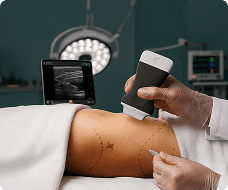
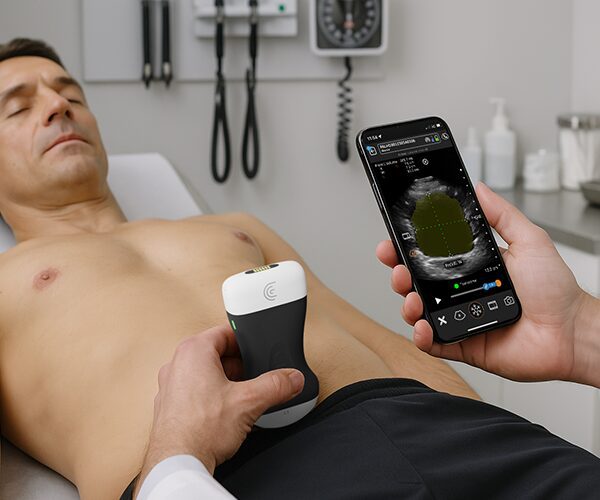
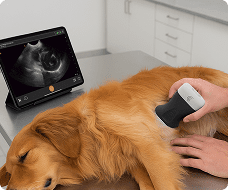
all right dr boison let's go ahead and talk about the umbilical site all right so the umbilical side again depending on patient position and how comfortable our patient is we may change how we scan that umbilical site so we're thinking for example if we're looking for free fluid one of the key things we look for at that umbilical site we got to think about patient positioning and where pathology accumulates so in this case we're looking for free fluid if our patient is in lateral as penny as now then we're going to come back to that umbilical site we find that simply by separating the fur finding that scar from when they had their ovariosterectomy in our female dogs or at that umbilical site in our male dogs we apply alcohol after we've separated the fur again we'll start with a marker towards the head we come in at that umbilical site now when we come in on that biblical site if our patient is in a standing position we're going to come in with the probe directed towards the spine as you see here because that fluid is going to accumulate along the body wall if our patient's in lateral as we see now and fluid is the question we want to answer we've got to direct that probe down towards the table top where my fingertips are here so we pick up that fluid in the gravity dependent region so always think about the pathology you're looking for in this case fluid and where it will accumulate and adjust your protocols accordingly so i'm scanning now down on that body wall because my patient's in lateral recumbency i'll rotate or rock the probe cranially and i'll rock the probe caudally and then i will also fan at this location to increase the area i look at lots of intestine in this area as well we don't tend to look at a lot of motility at this location if you see it great it tells you that you do have gm motility there but this area doesn't have as much contraction as the proximal gi tract so we look for foreign bodies or abnormalities if you get good without sound but we're really looking for fluid and we don't tend to pay a lot of attention to the intestine here the other thing we'll look for here dr schlub is going to be the spleen and there you go we can see the spleen now and we can actually follow that spleen we can trace it along very nicely we can fan and uh sweep along that spleen looking for any obvious masses or abnormalities i'll say just like the intestine we haven't done a lot of research to say non-specialists can identify intestinal foreign bodies or abnormalities the intestine beyond gi motility we have not done any research to say what the accuracy of non-specialist is at identifying masses or lesions in the spleen but the spleen is there and it is pretty easy for us to scan at this umbilical site once we've done the long axis again we'll turn into the short axis just to make sure again we haven't missed any pathology you see some nice intestinal loops here with some shadowing no obvious free fluid and then again i can pick up that spleen so that is our umbilical side doctor's lube essentially with the key component of looking for fluid although we can also see intestine and spleen at this site as well all right binary question is there free fluid at this site yes or no you