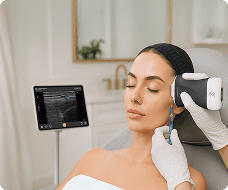
hi Dr John Arlette and Calgary Alberta Canada in following through our you know simple approaches to the face when you're going to begin Imaging we're going to move on to the dorsum of the nose and the forehead you looking at this as an area that's important to understand the structures and the appearance of particularly the vessels in this area we're going to be looking for the dorsal nasal artery we're going to look for the supratrochlear and supraorbital artery and we're going to take a look at the thinness of the tissue on the forehead as well as the dorsum of the nose for those who inject in that area so you want to fill that little defect up in order to be able to see well now let's put on our color Doppler here we are in the dorsum of the nose we see some vascular structure we have the dorsal nasal artery pounding below us it's located about well let's just measure we can do that the dorsal nasal artery is 1.8 millimeters below the surface of the skin in the dorsum of the nose so that's an important thing to know if you're injecting in that area and the dorsal nasal artery it can be singular or it can be bilateral I found it on the one side and there's the other side now when we're looking at these doppler images blue and red simply detecting the flow of vessels or not whether it's a vein or an artery if we're looking at vascular flow if it's blue actually the vessels flowing away from us if it's red it's coming towards us so there we have the dorsal nasal artery we'll see how and this should actually disappear into the bone and because of its origin from the ophthalmic artery you can see how really bounding that vessel is and that goes back into the tissue it'll go deep and then disappear inside the orbit so that gives you an idea when you're injecting what you can expect from that in the location of that dorsal nasal artery and we're going to scan up now we're going to move from the dorsum of the nose we're going to look for the super trochlear there it is right there just as we come up and now we can see that the forehead is very thin so here we are in the midpoint we're seeing this super trochlear arteries left and right side can't press them away and her frontalis muscle so what we're seeing here in terms of we see the pericranium we see the frontalis and then we see the surface of the skin of the forehead and we'll get different images based on the characteristics of the tissue in the different in the different layers so that we'll get more return because of from bone and we will from muscle or from from fat so these will have different appearances when we're looking at that degree of echogenicity and so here I've moved over a little bit there we have we're just following the super orbital artery Superior you can see the supratrochlear artery medially you can follow these vessels quite nicely if we look here on this we'll see how the pericranium is reflecting bright white we want to keep our device focused vertically to that so it's a very incompressible tissue so it sends lots of sound waves back we see the frontalis muscle through here and at this point the supraorbital artery has not yet risen up through just in the middle of the frontalis muscle it'll rise up through it after about a centimeter and a half and then we see some of the fat in the superior aspect of the image of the forehead and so if we just follow this vessel up a little bit more and we'll follow it as it rises up in the tissue now let's see here such a great demonstration this is the super orbital artery we can see that goal we're going up through the forehead we can follow it let's come back down to the midpoint in the forehead so we can see the central vessel is a vein because when I press on it it goes away I'm having a little bit of fun so you can see where I'm pressing on this this vessel is not going away so here we are with the super orbital artery following it up high in the forehead great example of looking for vessels on the the forehead if that's an area where you tend to inject foreign