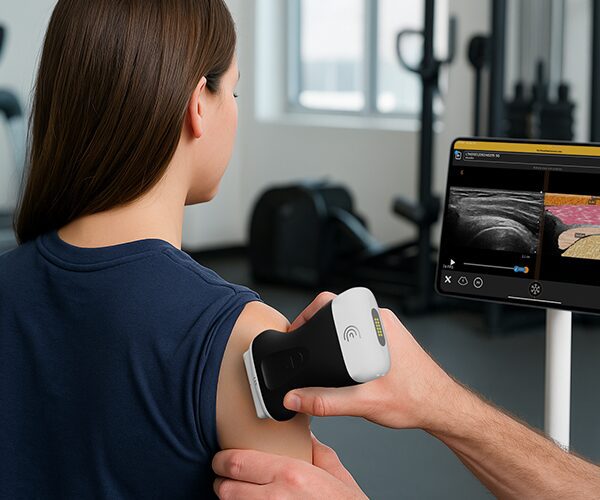
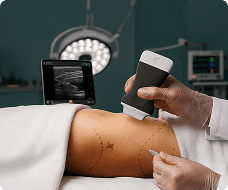
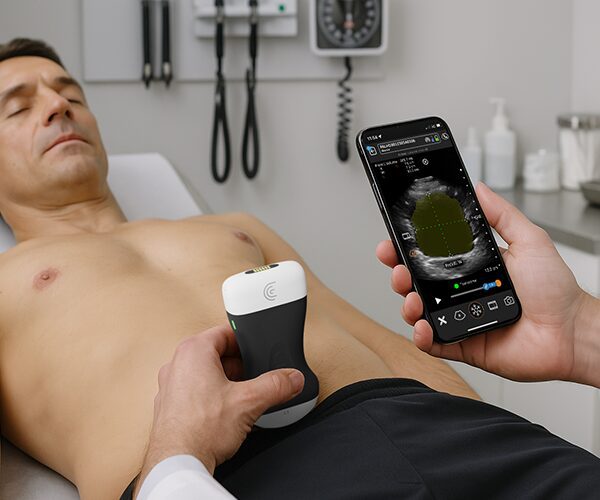
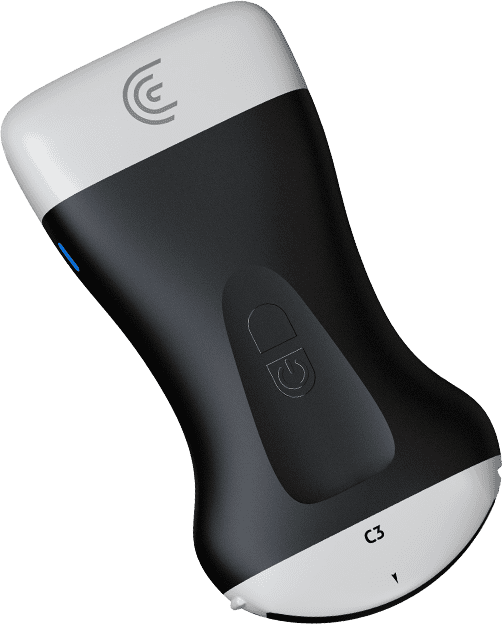
hi I'm Tom Cook I'm an Emergency Physician I practice in South Carolina with Prisma health and the University of South Carolina this is a video about selecting appropriate targets to access peripheral veins by using ultrasound we'll Begin by examining the medial aspect of the upper arm this is the most common place we tend to look for appropriate targets for peripheral venous catheters by ultrasound just because the vessels tend to be very large they're above the antecubital fossa so that if we want to do contrast enhanced CT scans or other studies we're able to do that and typically we place a catheter in this area can stay in there for a number of days without being changed out to a different location when we do this it's important to understand the orientation the top of the screen is now the medial aspect of the arm you can see that these vessels right here are pretty easy to identify and then we also see the humerus down here with the shadowing that that bone creates now we're only really interested in the top part of the screen so we're going to decrease the depth and now we need to identify different Target structures that we could potentially place a catheter when we do this we see several round or ovular structures that more than likely represent vessels that we could get involved with or that we could use for this procedure but we need to figure out which ones are veins which ones are arteries and which ones may potentially be nerves and the simplest way to do this is just by compression so you can see as I apply compression to the soft tissue the medial arm that there's one vessel in particular a large one just to the right side of the screen that compresses and so this seems to be a very very good targets obviously a vein or if you look at the vessel to the left of that structure it does not compress and that would indicate that it's most likely an artery you also interestingly enough have another structure just superficial to that artery that we've identified and that looks like a sort of a honeycomb appearance in that in this particular case is the median nerve and so in general we want to do everything we can to avoid in any way injuring nerves particularly this nerve is an important nerve and so this is another reason ultrasound is really really beneficial for using in procedures because we can direct the needle in the catheter well away from the structure and avoid any potential injury there are a couple other strategies you can use if you're considering using ultrasound to identify arteries or veins and this has to do with color Doppler so I'll go ahead and deploy that and we'll go ahead and resize this box just a little bit and you can see that if I place it over this particular structure and I angle the transducer so that it points towards the patient's head so the blood flow is moving towards the transducer I get a pulsatile red signal and this of course indicates that the patient that particular structure is an artery now if I take that same box and I move it just a little bit to the right and I look at that I really don't see any pulsatile activity I do see a little bit of blood moving away from the transducer so that makes me think it's a vein but I can even go one step further and compress the soft tissue distal to where I'm scanning and you can see that I can flush that vein with blood which is picked up on color Doppler and this is called distal augmentation so it's just another trick you can use to very precisely understand which structure is an artery which structure is a vein now let's go back one more time to this idea of the median nerve being in that area and again this structure is a sort of honeycombed appearance here one more thing to keep in mind is if we compress the tissue nerves just like arteries do not demonstrate any compression whatsoever the next thing you'll want to do when you're looking at these structures and you've sort of made some decisions is is this a good Target to go after so maybe the vein is very very small or it's a bit deeper the deeper The Vessel the harder it is to cannulate and so just a couple of rules of thumb to go by the first one is you want to try and find vessels that are at least four millimeters wide remember you're trying to put some pretty big catheters in these vessels and so vessels that are four millimeters wide or greater uh tend to be better targets and so for this situation I'll go ahead and freeze the image and I'll go up and bring some calipers to measure this structure and you can see just looking at that this is a this is a pretty good structure right here eight millimeters that's a really great structure to go after for putting a catheter in and then the second criteria I talked about was how deep this is and we can see that this is only about four millimeters deep so this is a fantastic vessel to go after if you're going to try and place a peripheral catheter the last thing I'll bring up is you would like to get some idea of the path of the blood vessel and if it is in fact straight and so there's a couple ways to do this probably the easiest one is just to start to move the transducer up and down the arm trying to keep the blood vessel in the middle and you can see as as we move this up and down the arm that blood vessel that big vein that we would like to consider to be a Target pretty much stays in the middle of the screen and this makes it a lot easier when you're passing the catheter so it doesn't make a sudden turn one way or the other and you end up missing missing the vein and not successfully completing the procedure summary when you go and look at these structures to identify appropriate vessels for cannulation remember compression is the easiest thing to do to differentiate arteries from veins and that you would like to go after veins that are not more than one centimeter deep and at least four millimeters wide in diameter thank you