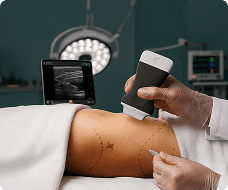
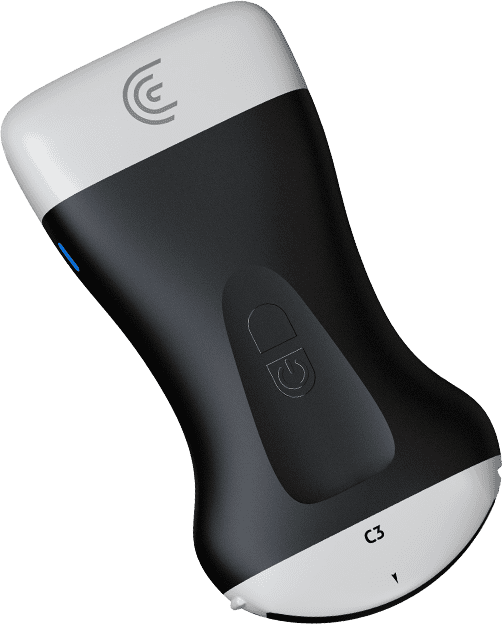
Hello, my name is Dr. Tatiana Hoverlo. I'm an emergency physician and founder of Hello Sono. We help medical practices launch compliant and high quality focus programs. In this video, I'll show you how to perform a lower extremity DVT ultrasound. First of all, let's start off with the indications. Those would be typically unilateral leg pain or swelling and a patient that has some risk factors for a DVT like immobilization or recent surgery. You want to position your patient supine and have them externally rotate their leg with the knee slightly bent. I have already selected my application to be DVT in the settings and I am going to scan uh deep vasculature of the leg uh with my probe in a transverse orientation with a probe marker pointing towards patient's right. We are going to do a simple threepoint compression technique for this proximal DVT scan. So we going to start at the inguinal area uh and get the compression there and then get mid thigh and the pelvic region. All right. So I'm going to start proximally. So I typically like to identify over here we see safal junction. So on the left side of the screen or lateral on the patient we see the femoral arteries that already split and on the right side of the screen we are seeing the common femoral vein and great saffronous vein right here. So once I identify this area I will actually move my probe just a little bit proximal to that area. So this is my common femoral vein and the two arteries on the left side of the screen. I'm going to go ahead and compress the vein and then I'm going to let go and I'm going to move just a little bit distal to get that SFJ Oopen femoral junction and I'm going to compress one more time and let go and then one more time in that same region I am going to get the deep deep femoral vein and the superficial femoral vein uh confluence and compress there as Well, let me just find that. So, we our two arteries are not compressing and the veins are compressing. So, I'm just scanning back and forth. Here you go. This is the area you want to be compressing. This is the confluence of deep femoral vein and femoral vein. So this is the deep femoral vein and I'm going to compress over here and the arteries are not compressible. And then I'm just going to follow out the femoral vein down the thigh. So I'm going to compress. So the femoral vein in this region is going to be underneath the artery. So I'm just compressing it as I'm sliding my probe downward again. again. So this confirms that there's no DVT in the inguinal region or the mid thigh region. And now we are going to transition uh to the papilal region to look at the papl. So I like to make sure that I see the cortex of the bone deep to my veins to make sure that I'm deep enough and looking at the deep vasculature, not the superficial vasculature. Uh so I'm going to go ahead and compress here. So in this area, the paplotil vein is on top of the artery and it's fully compressible. Uh so this confirms that this our patient here does not have a proximal black DVT. Some of the other things that you can identify with the ultrasound when you're evaluating patient for lower extremity DBT uh could be doing a soft tissue scan or a muscularkeeletal scan to look for Baker's cyst in the paplal region and also looking for muscle strain. Uh so that's an additional benefit of doing point of care or ultrasound. Ruling out a DVT in primary care setting uh is really impactful for patient care. you might be preventing this patient from needing to go to the emergency department. Uh there's definitely costs component as well. Um and obviously patient satisfaction. Thank you for watching this video. Please check out hellos.com if you want to learn more how we can support you in launching highquality, compliant, and profitable focus program. Uh check out the rest of this video series for more useful tutorials.