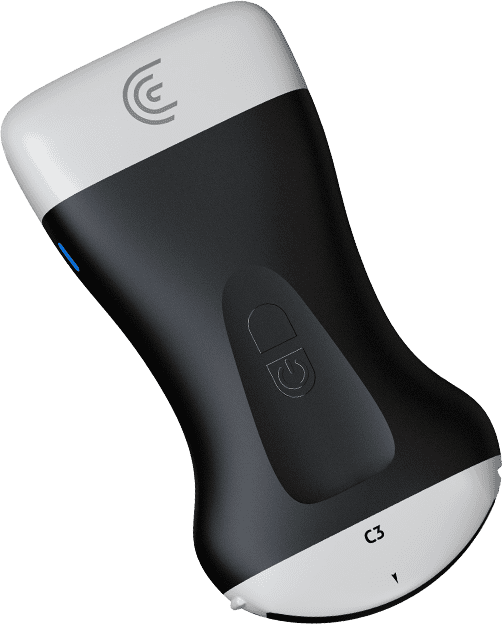
Hi, I'm Angie. This is Julie. This is OT. And we're Aspy Ultrasound Consultancy Services. Now, today we're going to go through step two of our eightstep abdominal survey. Now, what's included in step two? Well, step two includes the stomach, the giodinum, well, the proximal geodinum and the pyloris. And hopefully, if we can see in OT, we're going to tell you how you can locate the left limb of the pancreas. So we're going to start in the midline in long axis. So we're going to orientate the probe so that the orientation marker goes to the patient's head. And as usual, that's going to correspond to our clarius icon, the left side of the screen if we have our preset correct. It's an abdominal preset rather than a cardiac one. So remember, the stomach lies across the patient's body in both dogs and cats. So when we're scanning a long axis section, we'll actually be looking at a short axis section of the stomach and the left limb of pancreas. So let's place the probe long axis in the midline subzifoid. And here we can see our stomach. Now we've got these little involutions going on in that um mucosal surface that luminal surface and these are the rugal folds of the stomach. Quite normal. So what we want to do is have a good look around globally at the stomach as we move all the way up fanning up towards the ceiling. Here we've got stomach. We're just coming off the stomach now. And then back down fanning down towards the table. And of course this is going to take us in the direction of the diodinum and the pyloris which will just start to come in down here. There's a bit of jodum. It's going to go down round the bend and into the stomach. So how do we assess the stomach? Well, we want to look at the overall thickness of the gastric wall. Motility is going to be helpful to see. We can see that there's movement in the stomach here squelching around in there doing its job. We want to look at those characteristic wall layers of all aspects of the GI tract, especially the stomach, the geodinum. So, let's have a look here. You can see that it starts off with the wall being quite hypocoic then hypercoic hypo and then you have this bright fine sorosal margin around the outside. That's the normal pattern. Now if you have a loss of wall layering then that may be that there is some sort of disease process going on. So when looking at the gastric wall layers, it's quite helpful to play with the dynamic range because we've got a black white black white wall layer and you can see them coming into view here. By going down on the dynamic range, you're enhancing that contrast so that you should see that wall layer pattern a lot better than if you have a high dynamic range. Very useful tool. So again, you can see a little bit of small intestine there. Looks like a coffee bean, but you're quite clearly seeing the black and white next to it. Now OT has got quite a lot of gas in her stomach and you can see it squaltching around. What I'm going to do is just freeze the screen here and I'm going to measure a representative gastric wall thickness. And here we go. 3.5. That's nice and normal. Um, and we want to make sure that that's kind of kind of uniform around the area of the stomach that we can see. Now, it makes sense that if you have a lot of gas in the stomach, you're not going to see that dorsal wall because gas is our enemy. The sound can't pass through it. So, unless we turn her over and look at it from the other side or we come underneath the dog, we're going to struggle to see that dorsal wall. So, it's really important to sort of think of it as a a hollow structure and that we have to try and assess as much of it as possible. So, back to dynamic mode here. We've got little rugal folds here. Scanning all the way through. So I'm fanning upwards towards her rib cage until I run out of the stomach. And then I'm going to go back down to the horizontal aspect. Keeping at the level cranial and cordly with the stomach in the middle. I'm going to scan down towards the tabletop. And that's going to take me into the outflow tract and the pyloris down there. Brilliant. Okay. So, we've had a quick look at the stomach. If you were looking for a foreign body, then it's inside this area that we would be looking. Don't overall it though because you can see you've got little bits of ingest here which are casting little shadows. So, you want to have something that's got a nice sharp acoustic shadow if you're considering um a foreign body that's attenuating. Now, how are we going to look at the stomach in long axis? Well, it's quite difficult actually because when you rotate on it, the rugal folds tend to become quite stripey when it's empty. So, I find it much easier to assess the wall thickness in short axis. But, it's still important to look at all of the stomach in more than one plane. And if we're now going to go and try and find the pancreas. So, we've got colon here, cordal margin of the stomach here. We might actually want to try and just soften that up a little bit if I can. I might have the wrong depth. Let's just go back down to there. Dynamic range. Let's move that there just because we want to look at something that's in between the colon and the stomach here. And it's this area here. So, let's now increase that. So, this is our left limb of pancreas. And I know that because it lies vententral to the portal vein. Let me just show you. Oh, there's the portal vein coming in. Just getting a whiff of it. Here we've got our colon with the gas shadow. And then we happen to have our cordal margin of the stomach here. So our pancreas lies between left limb of pancreas lies between these three landmarks. Nothing else can be there. So if you have a normal pancreas, then the chances are it's going to be quite difficult to see. So you could be going, "Really, Angie? Are you sure that's a pancreas?" But this is a a little short axis section of the midline of the left limb of pancreas. If it's an angry pancreas, it's going to be large hypocoic, often surrounded by um hypercoic fat because it's reactive fat, and it's going to be waving at you to be perfectly honest. So if it's hard to see, the chances are that it's normal. Now, obviously, we've only just got a little thin section of it there. So, I want to just scan across the midline and make sure there's no big masses anywhere. So, it's difficult. Again, you often need to press in a little bit because here's our colon. There's our cordal margin of the stomach. And I'm sorry, Otie, but just pressing in a little bit. Our pancreas is going to be in here, this area here. So, she's only young. It's all nice and normal there. Again, just a little whiff of it there again. So left limb of pancreas in a dog is not quite so easy to see as the right limb and in a cat the left limb of course it's the opposite way around is the easier one to see. So the pancreas once you've located the level of it you can rotate on it and attempt to try and find it in a sort of long axis of the pancreas but short axis of the uh the dog. And this is pancreas just coming in along here. >> Nice >> with the eye of faith. Okay. So that's how we would assess the stomach. Now the pyloris I'm just putting a little bit of pressure on here. So the pyloris is just down here and this goes off into the geodinum. Now we're going to follow the geodinum in a in a bit. We're going to follow that. There's a douadinum here upwards from the underneath of OT in our um final step and we're going to go up into the stomach. But it's really important that you connect these two so that you know that you're definitely on that descending diodenum. And here we have the descending geodina. Again, quite contrasty that image there. So just go down a little bit. We go. And now go back up. There we go. You can see the characteristic wall layers of the geodinum. So that's how we would assess the stomach. There's our portal vein. There's our colon. There's our cordal margin of the stomach. And the pancreas has to lie in between those. The left limb of pancreas.