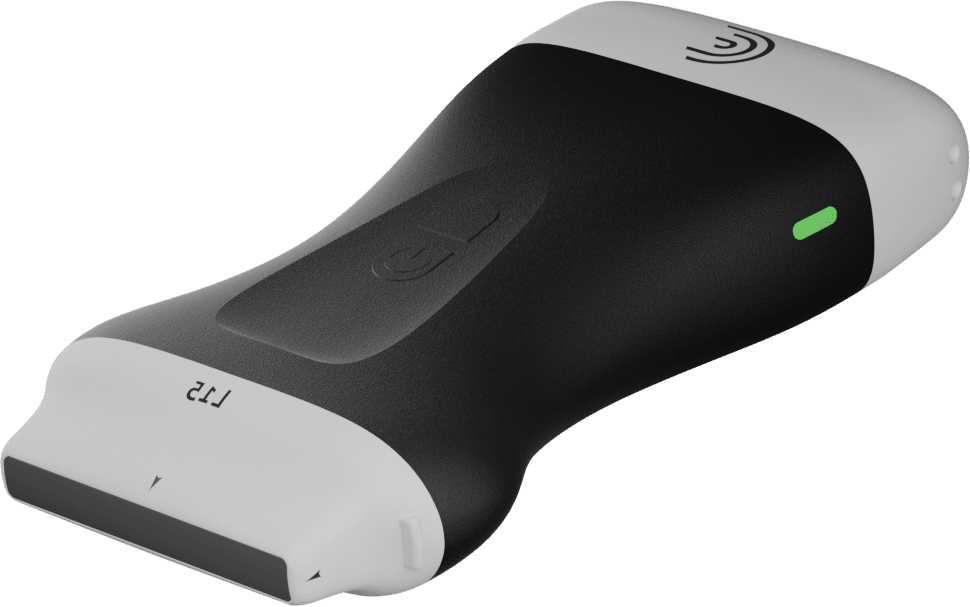
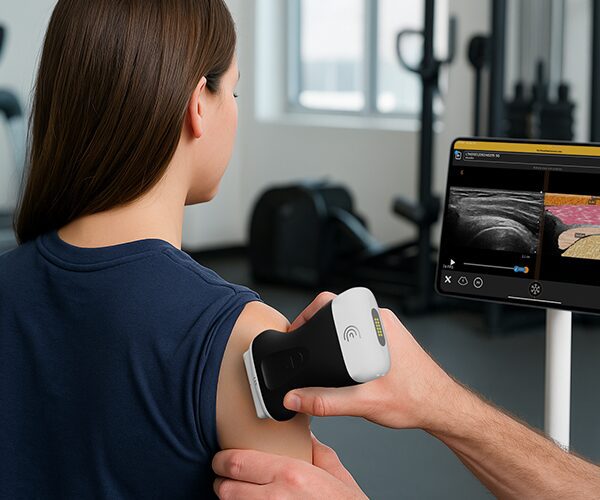
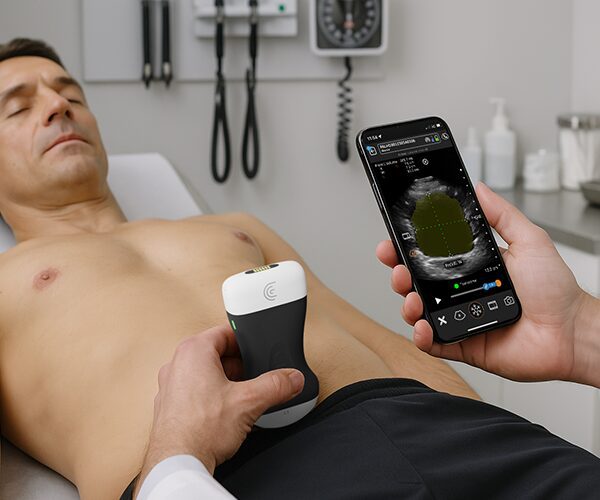
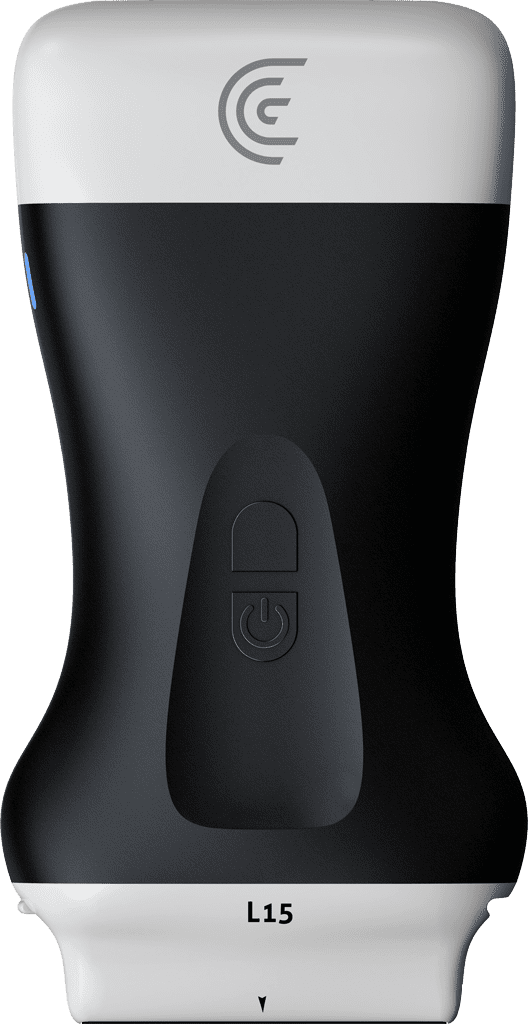
I have this patient here that I can demonstrate the findings of diastasis recti using the L15 clarius handhair ultrasound. Okay. So I always start with a scalp scan just to get an idea of how thick the abdominal fat and the tone of the rectus muscle is. So we can do the scalp scan relatively quickly. Okay. Now the scalp scan looks normal. Now so I will start uh by assessing of the diastasis recti right at the target which is a linear alba. So I start all the way from the top. I can feel the zyphoid bone. And then I start in this area and I go down in transverse view and and then I keep going down and so before I start my day diastasis recti scan I actually engage with the patient and I will tell her increase death. Okay, I will tell her what I'm seeing so that she can seeing the scan with me. So I again I ask her to breathe with her belly. Okay. So I'm explaining to her again the part that move the most is her internal organs. Anything above the the the organs is the muscle and anything above the muscle is the subcutaneous tissues and up top is the skin. Yeah. So, she never had she never seen a she never seen an ultrasound before, but we can educate her by engaging her and showing her what I'm seeing and she can understand what I'm seeing. Okay. So, I start with the rectus on the left and then I go into the midline to show her how the rectus tapering off into the midline and become the linear alba. So that's a midline, the linear alba. When I find the linear alba, I go all the way to the top. Okay, I can feel the zyoid bone. And then this is where I going to start my scan downward and I make sure that the patient is following me. gamma. >> So the the the midline marker here is very useful because we just keep the linear alba in in the midline and we keep going down >> and she I'm asking her is she's seeing the the linear alba become widening and she's telling me yes. So she's telling me up here the gap is small but as we go downward it's become widened. Okay. So there are two uh areas that interest me. The first area is 3 cm above the umbilicus. Okay. So this is about that level. I will freeze and I will do my measurement roughly from one rectus to the other rectus is about 26 mm. So this is more than 20 mm. So she definitely had some diastasis uh uh recti. or separation of the rectus and the other and then we can also measure the thickness of the linear alba here and her thickness is not too bad. Her thickness is about 1.9 mm. So she doesn't have this fin out of a linear alba. It's just that her rectus muscle is separating. Yeah. So she has this very thick linear alba. So it helps her um doesn't it's the abdominal bloating is not as bad as in somebody with this very widening gap and if the linear alba is a lot thinner. Okay. So another information that is going to be useful for me is the maximal widening. So again, I start from the top and I keep going until I think that the widening the the widening of the linear alba is a maximum and usually this is every patient will be different but you just have to use your best judgment and I think that this is where it is most widened. Okay. Freeze. So I just move this from one to the other. So at the maximum widening is between 26 or maybe yeah no definitely about 26 mm. 27 mm. Okay. Okay. And then I capture this information. So with these patients I will make a note that the w the the most widening gap of the linear alba is between 27 mm and when they on table I will try to find this this maximal widening gap again and I will mark uh on table so that I know that my I want to make sure that my area my my area of plecation is is as high as possible above this maximum widening gap. And this also helped me choose the width of my plecation. Okay. So we just quickly scout the lower abdomen to see if the sorry the extension goes all the way down. There is no separation below. I guess you you can see the left rectus and the right rectus meet in the middle. Okay. So I'm showing her that from the left moving to the midline to the right. We can see that the linear alba it's thinned out a bit but there's no obvious widening. Right? So there's no widening in the lower abdomen. Okay. So this is can be a trap for surgeons if you don't do this ultrasound assessment because this patient often have a C-section. It's very attractive to do lipos suction and then use the C-section scar to go up and do a mini abdominal plasty and plycate the um the lower part of the rectus abdominis. But in this patients, if you do that, you may risk widening the gap up here because you're increasing the pressure um of the the in intraabdominal pressure on the linear alba in the area where it is the weakest. So I always do um ultrasound assessment for patients coming in here for um complaint or wanting a better abdominal shape because I don't want to do a wrong operation for these patients. Okay. So no gap, no rectus separation in the lower abdomen, just the upper abdomen. Okay. Also, it's very important to assess the linear seminal line in these patients because some patients may have a very thin out linear semile luna line. So, if you contrast it, so this is oblique muscle group and you go in and you see the linear semile lunar line. It's not thinned out in this patients. Is there a specific measurement? I've haven't came across um any paper any description of this the thickness of a linear semi luna line but what I do is I compare it to the thickness of the um linear alba and I want to make sure that the thickness of a linear semoluna line is thicker than a linear alba because I also don't want to over repair if I over plycate I will stretch I will stretch the linear semoluna line and this may risk a hernia apelion hernas in this area. So you can see the freeze. You can see the transversalis abdominis becoming the posterior sheath of the rectus abdominis here. And this is where I would like to measure my um linear semoluna line and it's 5 mm is good. So we do it for the right side. Again I find where the transversals transversalus abdominis becoming the posterior sheath of the rectus abdominis here or this side is even thicker. Um freeze and then I can measuring from here to here. Okay. About 3.5 mm. So that's also pretty good. 3.5 or maybe even four but this is a very thick uh linear similuna line and this mean that my plecation in the midline would would not would not disrupt the integrity of this of this uh anatomical structure. Okay. Now one last thing for patient with diastasis recti. I know that this patient get diastasis recti probably from her um two previous pregnancies but in uh but I will always look for intraabdominal fat in this patient because the other cause of um diastasis recti is obesity or intraabdominal visceral fat. If you have a large amount of visceral fat you are more tend you are more prone to develop diastasis recti such as in men with diastasis recti. Um, and one way that you can use an ultrasound to very quickly gauge the amount of intraabdominal fat is you look at the preparonial fat. And this uh you're going to start your scan near the zyoid and you look for the maximum thickness of the area right below your rectus. And you can see this bright line here. Okay. So I think this is the thickness. This probably the thickness part of a preparonial fat. So I will freeze and I will measure the thickness of this layer which is only 8 mm and I will capture this image and then I will go and also look for the thinnest part of a subcutaneous fat also in this you know midline plane transverse view and this is probably the area with the fness. I mean you can also engage the patient and ask them okay actually I engage the patient I tell her to look at this area the subcutaneous area and tell me when she thinks it's the finest agree so we both think that this is probably the fitness area so we freeze And then we measure it's 8 8.72 mm. So I can take the ratio of the preparonial fat where it's the thickest over the thickness of the subcutaneous fat in the abdomen where it is the thinnest and I get a uh abdominal fat index. And if this abdominal fat index is less than 1.2 two, it means that the patient doesn't have um a lot of visceral fat and this is an area of emerging uh interest and I'm I'm looking into this um and study it more but it can give you a rough idea of how much preparial fat and intraabdonal obesity that the patient has. It's very important to assess for intraabdominal obesity and visceral fat in patient with diastasis recti. And that is my ultrasonic uh assessment of diastasis recti using the L15 clarious handheld ultrasound. Thank you very much.