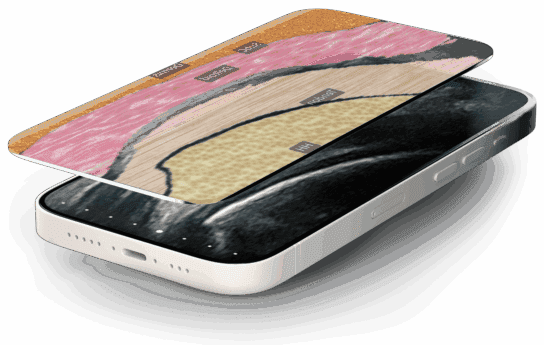
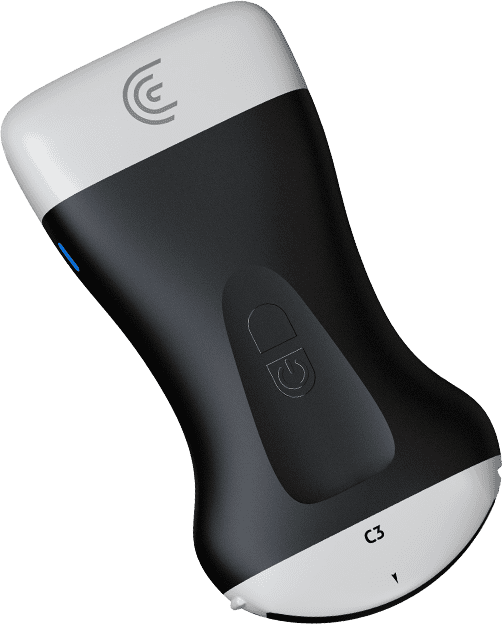
Hey, it's Dr. Steve Winer. The next area of the evaluation is going to be the lips. And on this particular area, and there's three areas of the face that have this is called T- mode, which uses AI to tell you the exact layers of the area you're evaluating. So, they have it on lips, cheeks, and temples. So, let's first do the lips. And I'm looking at the superior lip right here. And now I'm going to go into T- mode. And you see on T- mode, it's telling you the different layers. So what we're seeing right here is the subcutaneous tissue and we're seeing the muscle, the avicularis orus muscle. Also on T- mode, you can do something where it shows you the different layers on the left side of the screen. So, this is great to learn your anatomy. It doesn't do vascular just yet, but you can see the muscle well delineated on both sides of the screen. So, here's the muscle in the purple and the subcutaneous fat. That subcutaneous fat, that's where you want to do your injections with HA. All right. At this point, we're going to look at that superior labial artery. Uh, the majority of the time, it's going to be deep to the muscle. Let's see if that's the case here. So, there's a superior labial artery. A nice shot of it. You often don't get a very linear shot as you do here. And there's a little segment right over here of the muscle. So, this is deep to the muscle. And that's what you expect. in um 1 to 2% of the time that artery is going to be superficial to the muscle and at that point it's a little more at risk to have a vascular occlusion than if it's deep to the muscle. The inferior labial artery is going to be a little more commonly in uh the position above the muscle superficial to the muscle probably about 2 to 4% of the time. So let's look at the So let's go back a little bit. Let me explain this anatomy a little bit. So obviously this is the inferior labial artery and you see teeth here. teeth are going to be right here and here and here. And sometimes we're not sure when we're looking at an exam that we didn't perform, is this upper lip or the lower lip? And sometimes you can tell by the teeth. If the teeth are smaller, the incizers are smaller, it's going to be the lower lip. Um, if they're a little bit bigger, the more scalloped on the upper lip. Um, so that's how you determine if it's upper or lower lip. Again, here's the muscle. So, in this case, the artery is below the muscle. So, that's the most common presentation of the inferior labial artery. The inferior labial artery is going to be a little more tortuous. So, you're not going to see it as linear as the superior labial, which is more linear than the inferior labial. We're going to look at the T- mode on the lower lip at this point. And you can obviously see the different layers of the lower lip. And when you hit the freeze, you see the labels of the subcutaneous tissue as well as the muscle. I found that it's 100% accurate. So, it's a great AI tool to help the beginner learn the anatomy.