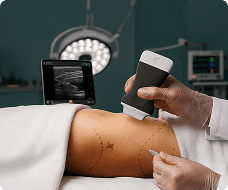
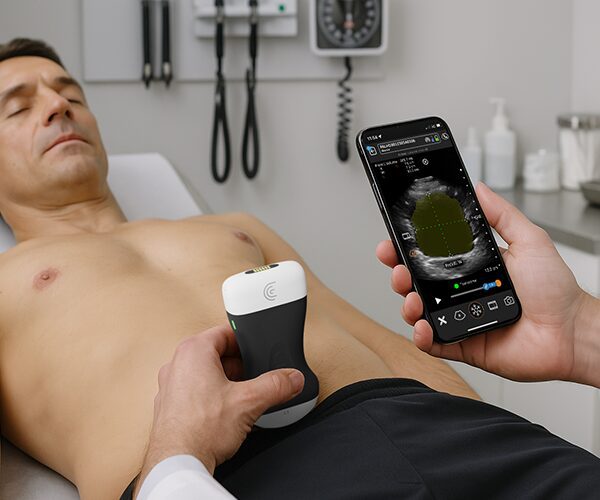
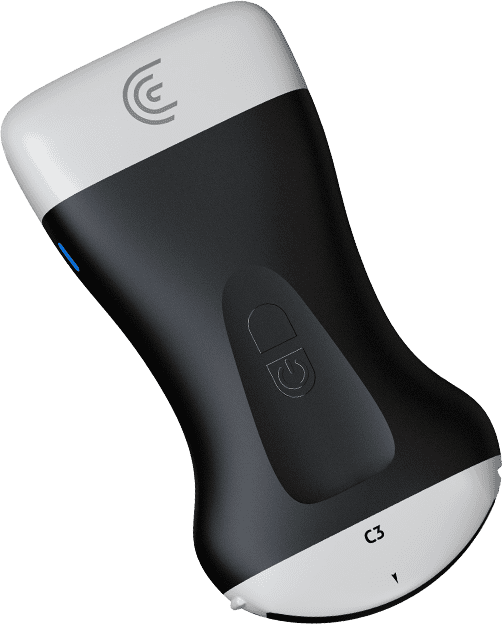
hi my name is Trent Raritan I'm a naturopathic doctor practicing in Cranbrook British Columbia and I'm here with Rico who's generously come in to offer his knee to be both scanned with Aquarius ultrasound and injected with duraland hyaluronic acid so for Rico's exam we'll start him supine on the table with his knee bolstered that allows for better assessment of the knee particularly in terms of the super patellar pocket injection but also comfortable for the patient in terms of releasing his low back so in terms of this scan we're just going to use Stan hexadine as the transducer medium simply because we are going to do an injection following this and then we'll also clean with chlorhexidine so I'll liberally apply the stanhexidine to the knee and place the probe long on his left knee on the left side of the screen we can see the proximal patella with a quadriceps tendon attached superficial of course is subcutaneous tissue and deep the white line is the femur just superficial to the femur is the pre-femoral fat pad sitting there between the femur and the quadriceps tendon and proximal to the patella is a super patellar fat pad the super patellar pocket is an extension of the capsule that comes from the joint and extends up and Rising more superiorly to land between the prefemoral fat pad and the quadriceps tendon so as part of the exam the first thing that we're doing anytime we're looking at doing a knee injection is we're scanning for how much fluid is in the knee joint and in Rico's case the knee does not have much fluid if there was a large fluid pocket we would see a large block space hypoechoic space just deep to the quadriceps tendon and in some cases that pocket will be very large and filled with up to 180 cc's of fluid typically for an injection it's not worthwhile removing any fluid unless there's more than 10 to 12 CC's the reason for that is in order to aspirate a knee you have to use a large bore needle typically an 18 gauge needle and there's inevitably some tissue injury when you do that aspiration and that causes bleeding and so one has to make a calculation between aspirating fluid so that you reduce the fluid volume into which you're putting Medicine of course it makes no sense to put a 3cc injection into 100 cc's of fluid that medicine is just going to be so diluted it'll have limited effect but if there's too little fluid and you aspirate then you'll cause bleeding and just local tissue irritation and end up with more fluid in the form of blood inside the joint capsule so that often negates the value of an aspiration of a low volume of fluid on the knee so in Rico's case there's not a lot of fluid it's also important to note that the capsule extends proximal to the patella and the lateral gutter in other words the lateral aspect of that pocket is typically quite a bit larger if there's a large knee of fusion that fluid will fill the lateral Gutter and you can access it with a very short needle from the lateral side of the leg so the second thing that we look at is the quality and the Integrity of the quadriceps tendon and what you're looking for are long linear uninterrupted fibers and one can tell very little from one plane in this plane it looks like a very healthy quadriceps tendon anytime you're assessing pathology particularly in tendons or ligaments you must assess that in two Dimensions so I'll go from long axis and hold in the same position into short axis and slide caudal cephalad to look for what we call fibular disruption which in the meat of the tendon would be black spots it looks speckled or mottled and that would suggest that there there's some Fiber disruption and I'm not seeing any of that on your knee Rico good sign second thing we can do is slide distal to the patella and examine the patellar tendon and in this case the fibers are long and linear with very little disruption again first and long axis secondly in short axis and very healthy tissue so this is all very superficial in the quadriceps tendon from the kneecap slide medial off the knee and down onto the medial surface of the knee and then slide distal to assess the Integrity of the medial collateral ligament and to get a broad sense of the health of the medial meniscus the other thing we're looking for here in addition to the health of the meniscus sometimes you can see if there's a tear in the meniscus you can see it if it's very superficial uh but more often than not ultrasound examination of the meniscus is not of great value one can easily see whether or not there's any spurring which is uh the formation of bumps right on the medial edge of the joint line and there's a little bit of spurring happening here which is not surprising given that Rico does have some knee pain associated with what I assume is some earlier moderate arthritis do we know that in your case we don't just just knee pain okay so as we're as we're scanning on the medial knee first thing we look at is the meniscus the second thing we can examine is the medial collateral ligament and one thing I will say is for people first starting in ultrasound scanning The Joint line is surprisingly distal so let's start again on the patella slide off and down one might think we'd be on the knee joint there but you actually have to slide quite a bit distal to find the knee joint so now I'm centered over the knee joint and I know Learners that I work with I myself when I first started using ultrasound was surprised at how distal it is so after you've examined the medial meniscus and the uh the medial surface of the femur and the tibia you can then look at the medial collateral ligament which is just superficial to the medial meniscus in fact the Deep layers of the medial collateral ligament are attached to the medial meniscus and Enrico's case the MCL or medial collateral ligament again looks very continuous notice how far proximal it attaches way up here and it travels way down onto the peasant serine it's a very long ligament and as we slide distal and as you see that very moderate sulcus there in the bone that is the Pez attachments or the peasant serine Rico just roll a bit onto your right hip just just ever so slightly yeah there we go let's start Square on the patella again and slide off lateral and in this case our Target is actually the proximal head of the fibula so place your fingers on either side of the proximal head of the fibula and drop your probe right onto that because that is the distal attachment of the lateral collateral ligament if you're trying to find the lateral collateral ligament without starting on the proximal head of the fibula you'll be hunting and pecking around it's it's tough to find but as long as your Landmark right on the proximal head of the fibula you'll be right there and so now we can see coming off so now I'm centered on the proximal head of the fibula and you can see those fibers extending to the right of the screen and slightly dropping down that is the lateral collateral ligament and it extends all the way along I'm still on it here and see I lost it it's a super thin ligament and easy to lose this is totally normal and you have to just follow the fibers and there were still on them nice long fibers there and attaching right here so that's where it attaches on the distal end of the lateral portion of the femur okay and in terms of the lateral joint line it is right right here one can look at the lateral meniscus there's there's much less to learn about the lateral meniscus on a knee exam than there is on the medial surface so in conclusion I would say Enrico's knee uh there's there's no fluid that needs to be aspirated the tendons and ligaments look healthy to my eye there is a little bit of lipping calcification forming on the medial surface of the knee here we're facing the limitation of sonography sometimes on a joint sometimes it can be exceptionally helpful sometimes not helpful at all and in Rico's case he's having pain everywhere the only pathology that I'm seeing is a little bit of calcification on the medial joint line foreign